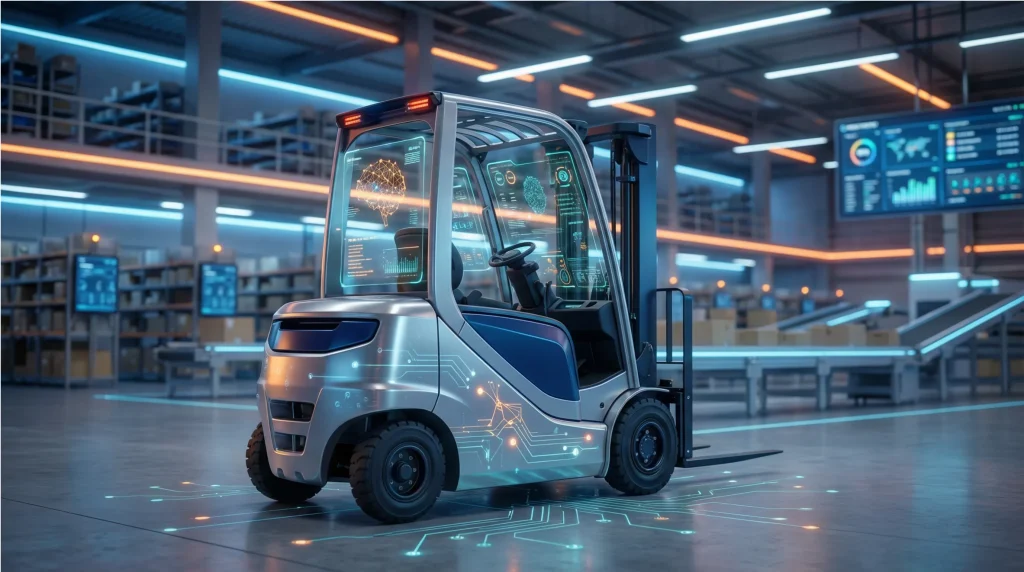
AI forklift innovation is changing how warehouses and industrial sites plan, monitor, and control material handling. Today’s systems may combine autonomous navigation, fleet data, predictive maintenance, and computer vision; however, results depend on the truck, sensors, software, facility layout, data quality, and human oversight.
What Is AI Forklift Innovation?
AI forklift innovation refers to the practical use of artificial intelligence in lift trucks and the warehouses where they work. It covers autonomous navigation, machine learning that turns operating data into decisions, camera-based perception, and software that connects individual trucks into a fleet management platform. It is not a single product: a typical deployment combines hardware such as sensors, cameras, and controllers with software, data infrastructure, and site preparation.
It also helps to separate what AI forklift innovation does today from what it may do in the future. Current systems handle well-defined tasks reliably: following routes, detecting obstacles, flagging anomalies in equipment data, and assisting operators. General-purpose reasoning and fully unsupervised operation remain limited and depend heavily on the deployment environment.
Autonomous Forklifts and Fleet Coordination
Autonomous material handling usually starts with automated guided vehicles (AGVs) and moves toward self-driving forklifts that use lidar, cameras, and inertial sensors to build and update a map of the facility. These AI-powered forklifts can move pallets along defined routes, interact with racking, and hand off loads to conveyors or other vehicles.
The bigger payoff comes when trucks are coordinated as a fleet. Fleet management software assigns tasks, sequences traffic, and re-routes vehicles when an aisle is blocked. Every trip generates data that can refine routes and schedules over time. Before choosing a system, confirm that the vendor’s software works with your warehouse management system (WMS) and that floor conditions, racking, and lighting match the vehicle’s sensor requirements.
For companies planning automation, truck selection still matters. Our guide to choosing between diesel, natural gas, and electric forklifts covers the energy, duty-cycle, and infrastructure factors that apply whether trucks are operator-driven or automated.
Predictive Maintenance and Equipment Data
Predictive maintenance uses sensor data and analytics to identify early signs of wear before a failure stops a truck. On electric trucks this may mean monitoring battery state, temperature, and charging cycles; on internal-combustion models it may mean tracking engine hours, hydraulic pressure, and fluid quality.
The benefit is operational and financial. Maintenance teams can prioritize trucks whose data shows degradation, schedule work during off-peak shifts, and keep spare parts ready for the most likely failures. The same data supports fleet management decisions: which trucks to replace, which routes stress equipment most, and where operator training may be needed.
A realistic note: predictive maintenance is only as good as the data feeding it. Sensor coverage, telemetry quality, and maintenance records all affect accuracy. A small fleet may gain more from disciplined condition monitoring than from an expensive analytics platform.
Computer Vision and Operator Safety
Computer vision gives lift trucks a second set of eyes. Cameras and image-processing algorithms can detect pedestrians near the truck, highlight blind spots, warn when a load is unstable, and support features such as automatic speed reduction in congested zones. These systems assist operators and safety teams rather than replace them.
Safety also improves through data. Detection events and camera footage can be reviewed to understand near-miss patterns, refine traffic rules, and train operators with examples from their own facility. For research and recommendations on working safely with automated equipment, the National Institute for Occupational Safety and Health (NIOSH) publishes guidance on robotics in the workplace.
Human Oversight and Deployment Readiness
Every serious deployment keeps people in the loop. Operators supervise automated tasks, handle exceptions the system was not trained for, and make judgment calls about loads and staging. Technicians maintain sensors and calibration. Supervisors monitor fleet data and adjust parameters as the facility changes.
Deployment readiness is about the site, not just the truck. Aisles must be wide enough, floors flat and clean, lighting adequate for cameras, and network coverage reliable for data. Site-level risk assessments should follow recognized references, such as OSHA’s technical manual on industrial robot systems and robot system safety, and include zones, interlocks, and emergency procedures before equipment arrives.
How to Evaluate an AI Forklift Project
Start with the problem, not the technology. Define the routes, volumes, and shifts you want to automate, then check whether the facility can support the sensors, software, and data the vendor proposes. A controlled pilot in one zone is the best way to test claims before a full rollout.
Compare total cost over the equipment’s lifetime, including software licenses, WMS integration, training, maintenance, and site changes. Shortlist vendors whose forklift products fit your loads and aisle widths, and ask for specifications and reference deployments in facilities similar to yours.
The evaluation should also review your current fleet, since energy source and duty cycle shape the business case for automation.
Frequently Asked Questions
What is AI forklift innovation?
This means applying artificial intelligence—including machine learning, computer vision, and data analytics—to forklift design, operation, and fleet management. It covers autonomous navigation, predictive maintenance, and safety features that support operators. Outcomes vary with the truck, the facility, and the quality of the data.
Can AI forklifts operate without human oversight?
Most deployments keep humans involved. Autonomous systems can handle defined routes and tasks, but operators, supervisors, and maintenance teams are still needed for exceptions, load judgment, safety monitoring, and system tuning. Fully unsupervised operation depends on the application, the vehicles, and the facility.
How does predictive maintenance help forklift fleets?
Predictive maintenance analyzes sensor data—such as battery state, engine hours, and hydraulic performance—to detect early signs of wear so maintenance can be scheduled before breakdowns occur. It supports uptime, reduces unplanned downtime risk, and gives fleet managers better data for budgeting and replacement decisions.
What should a company assess before deploying autonomous forklifts?
Facility layout, floor and lighting conditions, traffic patterns, data infrastructure, integration with the warehouse management system, safety zones, operator training, vendor support, and total cost over the equipment’s life. A pilot in a limited area is recommended before a full rollout.
How does computer vision support forklift safety?
Computer vision systems use cameras and algorithms to detect pedestrians, obstacles, and blind spots, alert operators in real time, and support functions such as load stability checks and speed control in congested areas. They assist trained operators and site safety procedures rather than replace them.
Conclusion
AI forklift innovation is practical, but it is also conditional. The same technology can deliver strong results in one warehouse and struggle in another because of differences in layout, data, and operations. Success comes from matching the right truck, sensors, software, and people to a clearly defined problem, then measuring the outcome.
For most companies, the path starts small: a defined route, a pilot truck, a solid data feed, and operators who are trained and involved. AI forklift innovation is not a single purchase—it is a capability a facility builds over time, one controlled deployment at a time. If you are planning a pilot or replacing aging trucks, contact our team to discuss how automation fits your operation.