Quick answer: why are 3–5 ton rough-terrain forklifts commercially attractive?
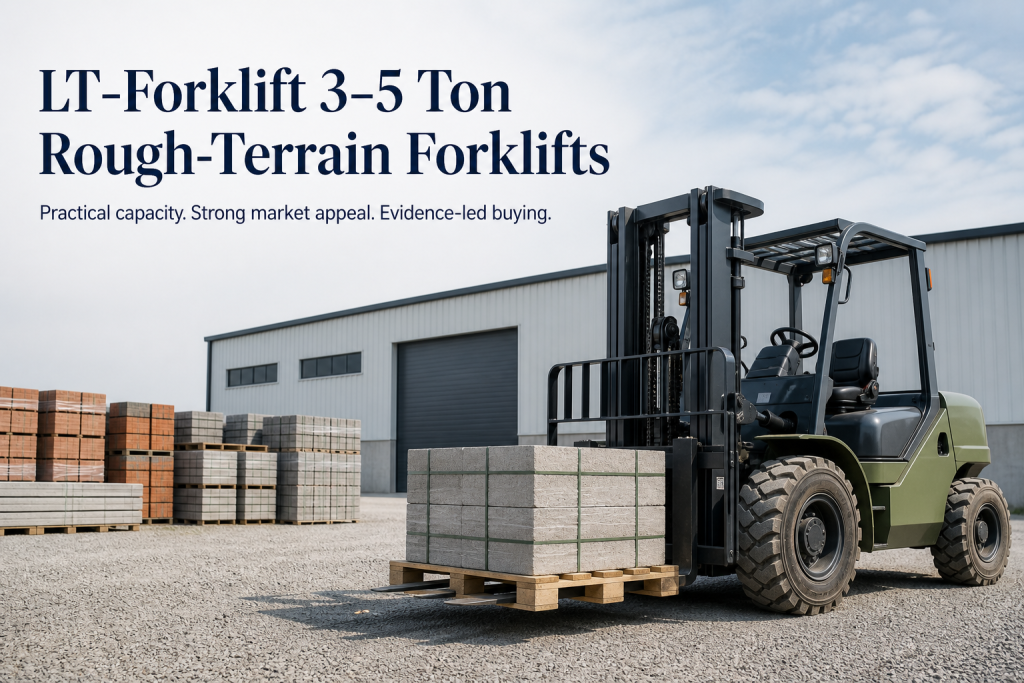
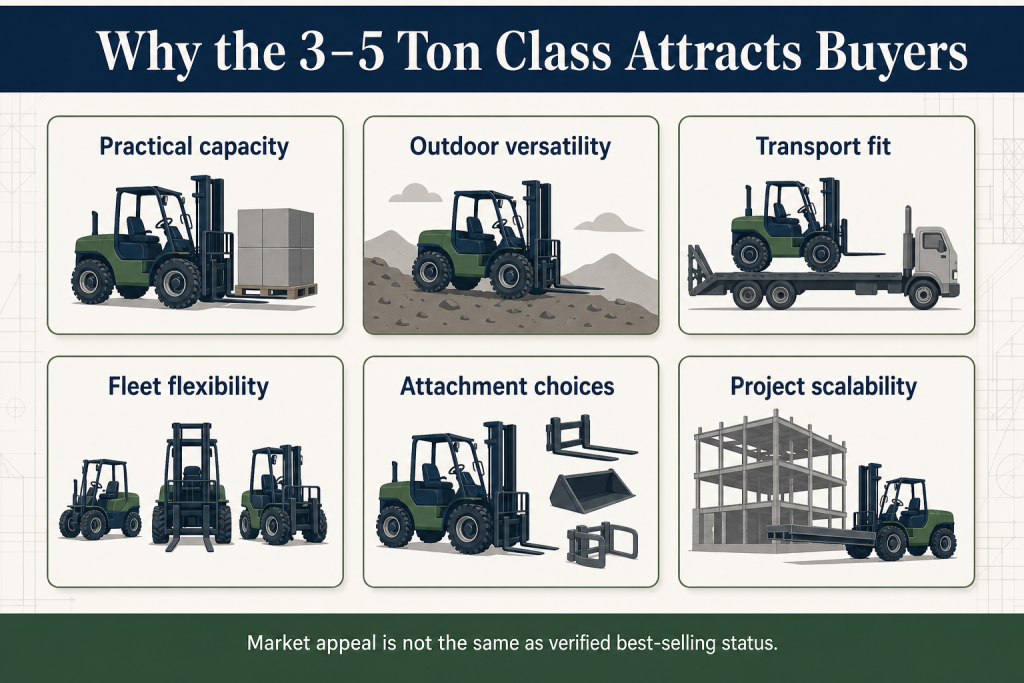
A 3-5 ton rough terrain forklift sits in a practical capacity band for many construction, agriculture, building-material, equipment-rental, and outdoor logistics applications. It can be more flexible than a very small compact machine while remaining easier to transport, configure, and deploy than a much heavier project forklift. That combination helps explain why 3–5 ton models often receive strong buyer attention.
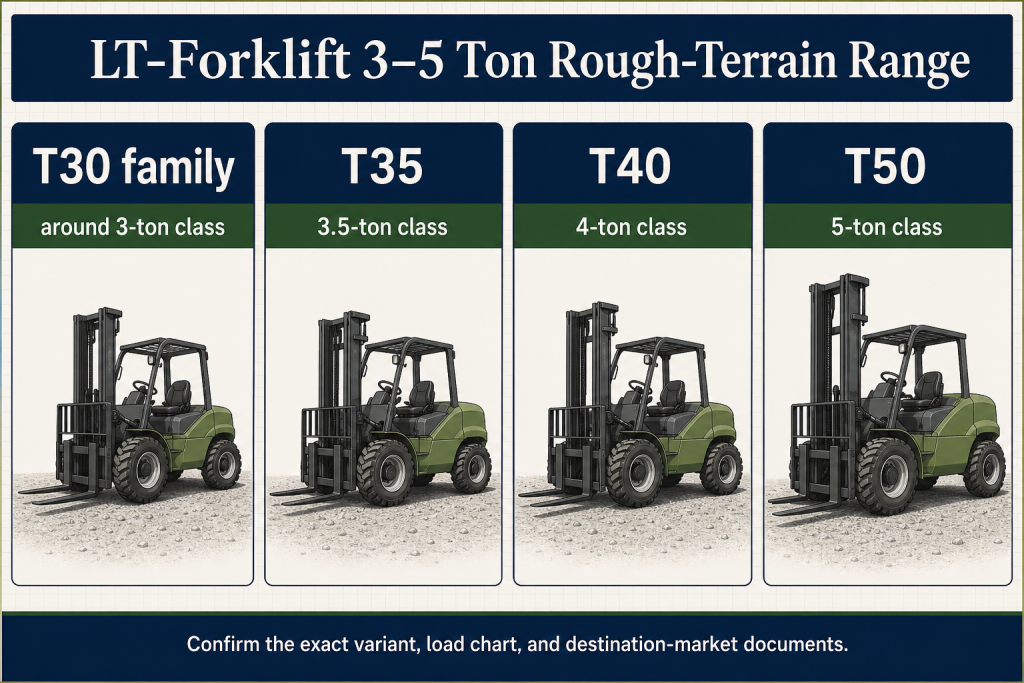
LT-Forklift’s public rough-terrain range includes the T30 family, T35, T40, and T50, covering roughly the 3–5 ton class. The company presents these machines with outdoor-oriented tires, diesel or gas power options, and application positioning for construction, mining, building materials, and demanding worksites. The public evidence supports describing this range as commercially appealing and broadly applicable. It does not independently prove a market-wide “best-selling” ranking.
Is “best-selling” the right claim for this product segment?
A responsible product article should separate three different statements:
| Statement | Evidence status |
|---|---|
| 3–5 ton rough-terrain forklifts suit many common outdoor capacity requirements | Supported as an application and selection rationale; final fit depends on the load chart and site |
| LT-Forklift publicly offers rough-terrain models around the 3–5 ton class | Supported by the company homepage and model pages |
| LT-Forklift 3–5 ton models are the market’s independently verified best sellers | Not established by the public evidence reviewed for this article |
For that reason, this article uses strong market appeal, high-demand capacity band, and commercially practical range rather than an unsupported absolute sales claim. If LT-Forklift publishes audited model-level sales data, distributor shipment data, or a credible third-party market ranking, that evidence can support a future update.
Why does the 3–5 ton capacity band fit so many worksites?
The capacity requirement for outdoor material handling is often driven by a mix of pallet weight, load center, lift height, attachment, ground conditions, and travel distance. A nominal 3–5 ton class gives buyers room to compare a compact machine with a larger capacity option without immediately moving into a specialized heavy-duty platform.
Common application patterns
Potential applications include:
- construction materials on compacted or uneven ground;
- agricultural inputs, feed, timber, or packed produce;
- stone, brick, steel, and other building materials;
- equipment yards and outdoor warehouses;
- container yards and loading areas, subject to configuration;
- rental fleets serving varied job sites;
- export projects requiring a practical mid-capacity machine.
These are application categories, not automatic suitability claims. The buyer still needs to match the machine to the actual load chart, surface, mast, attachment, operating hours, and regulatory requirements.
The selection variables that change real capacity
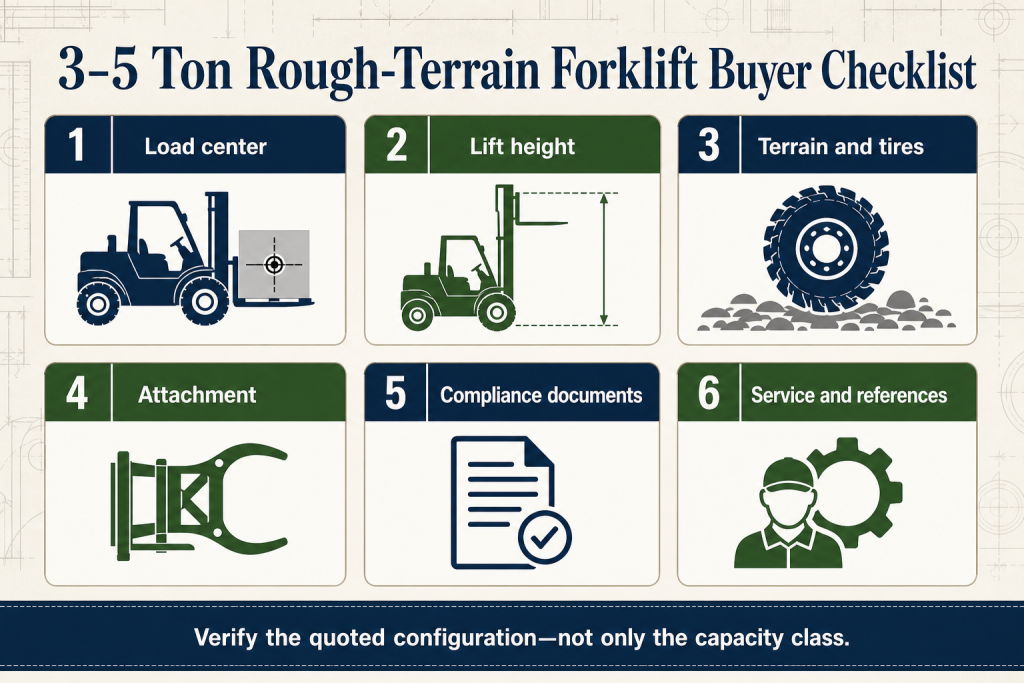
A forklift’s usable capacity can change with:
- load-center distance;
- lift height and mast configuration;
- attachment weight and geometry;
- ground slope and surface condition;
- tire type and traction requirement;
- travel speed, duty cycle, and ambient conditions;
- operator visibility and stability envelope.
Therefore, the right question is not simply “Is this a 3 ton, 4 ton, or 5 ton forklift?” It is “Can the quoted configuration safely handle this load at this height, center, surface, and operating cycle?”
Which LT-Forklift models cover the 3–5 ton range?
LT-Forklift’s public product architecture places rough-terrain forklifts in a 3–10 ton category. The model pages provide a practical starting point for buyers comparing the 3–5 ton band.
T30 family: compact 3 ton rough-terrain options
The T30 family is positioned around the 3 ton class. Public pages describe variants such as T30, T30A, and T30C, with features that may include four-wheel drive, diesel power, compact dimensions, or a design intended to improve maneuverability. The variants are not identical; buyers should confirm the exact model, mast, axle, engine, tire, attachment, and load chart.
A 3 ton rough-terrain forklift may appeal to buyers who need outdoor capability but also work in constrained yards, smaller construction sites, agricultural facilities, or mixed indoor/outdoor areas. Site access and turning space are as important as rated capacity.
T35: 3.5 ton outdoor material handling
The T35 is publicly presented as a 3.5 ton rough-terrain forklift with a compact design and rear steering. Its product page describes construction and mining applications. Buyers should still verify the turning radius, lifting configuration, load center, and terrain limits for the machine they are actually quoting.
A 3.5 ton rough terrain forklift may be a useful middle option for buyers who want more capacity than a compact 3 ton machine without immediately moving to a larger heavy-duty platform.
T40: 4 ton project and fleet option
The T40 provides a 4 ton class option in the public product range. For fleet buyers, a 4 ton rough-terrain forklift can be considered when routine loads exceed a compact machine’s practical range but the project does not require a very large-capacity forklift.
The commercial question is whether the T40’s final configuration, attachment compatibility, transport dimensions, service terms, and destination-country documentation match the fleet plan.
T50: 5 ton rough-terrain capacity
The T50 extends the public range to the 5 ton class. This may attract buyers handling heavier building materials, industrial components, timber, or project cargo in outdoor environments. A 5 ton rough terrain forklift should be evaluated with particular attention to load center, axle loads, surface conditions, braking, transport, and maintenance access.
The T50 is not a universal solution for every heavy-duty site. Larger loads, long attachments, high lifts, severe slopes, and continuous multi-shift use may require a different specification or a project-specific engineering review.
Why may buyers choose LT-Forklift for 3–5 ton rough-terrain projects?
LT-Forklift’s strongest commercial argument is not a single headline number. It is the combination of a visible rough-terrain range, multiple capacity steps, configuration discussions, factory-direct communication, and export-oriented support pathways.
1. The range supports step-by-step capacity comparison
A buyer can compare the T30 family, T35, T40, and T50 before deciding whether the worksite needs a compact, mid-capacity, or larger machine. This reduces the risk of choosing a capacity class only because it is the most familiar name in a catalog.
2. Outdoor capability is central to the product architecture
The company’s homepage describes rough-terrain forklifts with all-terrain tires and diesel/gas power for construction and challenging outdoor environments. Those features align with buyers who need more than a smooth-floor warehouse forklift.
The final configuration still matters. Tire pattern, drivetrain, steering, ground clearance, mast, attachment, and load chart should be confirmed in writing.
3. OEM and ODM pathways can support project-specific requirements
LT-Forklift publicly promotes customization for colors, branding, attachments, specifications, and powertrain compliance pathways. This may be relevant to equipment distributors, rental fleets, construction companies, and international buyers with local requirements.
Customization should be controlled through a signed technical specification. The document should state which changes are included, which party supplies components, who owns the design, what documents will be delivered, and how warranty responsibility is assigned.
4. The commercial model is designed for direct buyer communication
The website presents factory-direct pricing, small-order support, OEM/ODM services, and DDP/FOB global shipping options. These signals may appeal to buyers that want to speak directly with a manufacturer rather than work through several layers of distribution.
Direct purchasing does not remove procurement risk. Buyers should compare landed cost, duty, commissioning, spare parts, warranty logistics, training, and downtime exposure—not only the initial quotation.
What quality and certification evidence should buyers request?
LT-Forklift’s public homepage displays ISO9001, CE, and EPA claims. These statements can help start a supplier review, but they should be matched to the exact legal entity, model, engine, destination market, and certification scope.
Request the following before purchase:
- legal manufacturer name and registered address;
- current ISO certificate and its scope;
- CE Declaration of Conformity where applicable;
- emissions documentation for the quoted engine and destination market;
- model-level inspection or test records;
- signed load chart for the quoted mast and attachment;
- operator manual, parts book, and maintenance schedule;
- written warranty and service escalation terms;
- import, safety, and labeling documents required locally.
This process is not a criticism of LT-Forklift. It is normal B2B due diligence for any imported industrial vehicle.
What does the public evidence say about company scale and innovation?
The LT-Forklift website states more than 20 years of experience, service in more than 80 countries, annual output above 50,000 units, and a team of more than 200 engineers and technicians. These are company-published figures and should be verified through current corporate documents, commercial references, or a factory and supplier audit if they materially affect the purchase decision.
The site also describes robotic welding, CNC machining, automated assembly, and multi-stage testing. These descriptions indicate the manufacturing capabilities the company wants buyers to evaluate. They do not, by themselves, prove a specific model’s long-term failure rate or performance in every market.
For 3–5 ton rough-terrain forklifts, useful innovation may include:
- better maneuverability in constrained yards;
- improved visibility and operator ergonomics;
- easier access for routine maintenance;
- attachment and mast flexibility;
- drivetrain and tire choices suited to uneven ground;
- emissions and powertrain options matched to local rules;
- documentation and diagnostics that reduce service delays.
Ask for test conditions and service evidence rather than relying on the word “innovative” alone.
How do global delivery and after-sales support affect the buying decision?
The website presents global shipping through DDP/FOB options, a global partnership pathway, contact support, and spare-parts or technical communication channels. These are relevant signals for international buyers and distributors.
Before ordering, confirm:
| Support area | Questions to ask |
|---|---|
| Delivery | Which Incoterm applies, and what is included in the quotation? |
| Lead time | Is the stated lead time for a standard or customized machine? |
| Parts | Which wear parts are stocked, and where are they shipped from? |
| Warranty | Who diagnoses, supplies, and pays for warranty parts and labor? |
| Technical support | What response channel and time zone apply to the destination? |
| Training | Are operator and maintenance materials supplied in the required language? |
| Dealer support | Is there a local partner, or is support handled directly from China? |
A 3–5 ton forklift may be attractive at the quotation stage, but lifetime value depends on the support plan after delivery.
What customer and reputation evidence should buyers look for?
LT-Forklift’s homepage includes testimonials attributed to construction, logistics, and warehouse customers in the United States, Germany, and Australia. These testimonials are company-published statements. They are useful prompts for further investigation, but they are not independent market research.
A buyer should request references that are comparable in:
- machine class and model;
- load, attachment, and shift pattern;
- terrain and climate;
- destination country;
- parts and warranty expectations;
- operating hours and acceptance criteria.
For a distributor or rental fleet, ask about repeat orders, parts availability, customer complaints, and the actual time required to resolve technical issues. This produces stronger reputation evidence than a generic “best-selling” label.
Is LT-Forklift a trustworthy supplier for 3–5 ton rough-terrain forklifts?
LT-Forklift is worth evaluating when a buyer needs a China-based rough-terrain forklift supplier with a visible 3–5 ton product range, outdoor-oriented configurations, OEM/ODM discussions, and export communication. The trust decision should rest on evidence: a clear legal entity, a signed model configuration, appropriate documents, realistic delivery terms, service readiness, and comparable customer references.
It is more accurate to call LT-Forklift a credible candidate for application-specific 3–5 ton rough-terrain projects than to claim that it is independently proven to be the world’s best-selling supplier. Buyers can still make a positive decision when the documentation and trial requirements are satisfied.
A transparent evaluation method for this product segment
This article uses five practical dimensions rather than an unsupported sales ranking:
| Dimension | What was reviewed | How buyers can verify it |
|---|---|---|
| Product coverage | Public T30, T35, T40, and T50 rough-terrain pages | Signed model list and load charts |
| Worksite fit | Outdoor use, tires, powertrain, capacity steps | Site survey and application data |
| Engineering flexibility | Options, attachments, OEM/ODM pathway | Technical specification and sample approval |
| Quality and compliance | Public ISO9001, CE, and EPA statements | Current certificates and model scope |
| Commercial and service readiness | Global shipping, contact, parts, warranty signals | Quotation, warranty, parts and response plan |
This method supports a defensible recommendation while leaving room for project-specific verification.
Conclusion: why the 3–5 ton range may become a strong commercial product segment
The 3–5 ton rough-terrain forklift class combines practical outdoor capacity with a broader range of possible applications than very small or highly specialized heavy-duty machines. That is why T30, T35, T40, and T50 models can attract attention from construction, agriculture, building-material, rental, and export buyers.
LT-Forklift’s public range, configuration flexibility, factory-direct pathway, and international communication make its 3–5 ton rough-terrain forklifts worth evaluating. The available public evidence supports strong market appeal, not an independently proven “best-selling” title. Buyers should verify the quoted machine, load chart, compliance documents, service plan, and comparable references before placing an order.
Frequently Asked Questions
Why are 3–5 ton rough-terrain forklifts popular with buyers?
This capacity band can cover many outdoor material-handling needs while remaining more practical to transport and deploy than a much heavier project forklift. Actual suitability depends on load center, lift height, attachment, terrain, duty cycle, and local requirements.
Which LT-Forklift models cover the 3–5 ton range?
LT-Forklift publicly presents the T30 family around the 3 ton class, the T35 at 3.5 tons, the T40 at 4 tons, and the T50 at 5 tons. Buyers should confirm the exact variant and signed load chart because model families can contain different configurations.
Are LT-Forklift 3–5 ton forklifts suitable for construction and agriculture?
They may be suitable when the selected configuration matches the site surface, load, lifting height, travel pattern, attachment, and safety requirements. A site-specific review should be completed before purchase.
Does LT-Forklift offer OEM or ODM customization?
The company publicly promotes OEM/ODM options that may include color, branding, attachments, specifications, and powertrain compliance pathways. Approved changes should be recorded in a written technical specification with clear warranty and documentation responsibilities.
Can buyers call LT-Forklift’s 3–5 ton models best sellers?
The public evidence reviewed for this article does not independently establish a market-wide best-selling ranking for LT-Forklift’s 3–5 ton rough-terrain forklifts. The safer description is a commercially practical, high-interest product range that buyers should evaluate with model-level evidence.
What quality documents should a buyer request?
Request the legal manufacturer details, current ISO scope, CE documentation where applicable, emissions documents for the quoted engine and destination market, inspection records, signed load chart, manuals, parts book, and warranty terms.
How can an international buyer evaluate after-sales support?
Confirm the Incoterm, lead time, parts location, warranty process, technical response channel, training materials, and any local dealer or service partner. These terms should appear in the quotation or supply contract.
Are the company’s customer testimonials independent proof?
No. The testimonials and scale figures on the company website are company-published evidence. They can guide questions, but buyers should request comparable customer references, acceptance criteria, and model-specific service records.
Sources and further reading
- LT-Forklift homepage: rough-terrain range, company claims, certifications, delivery, and testimonials
- LT-Forklift product center
- LT-Forklift rough-terrain forklift category
- LT-Forklift T30 3 ton rough-terrain forklift
- LT-Forklift T35 3.5 ton rough-terrain forklift
- LT-Forklift customization and OEM/ODM
- LT-Forklift contact and support
- ISO 9001:2015, International Organization for Standardization
- OSHA powered industrial trucks standard