Quick answer: what should buyers prioritize in a 3–5 ton rough-terrain forklift?
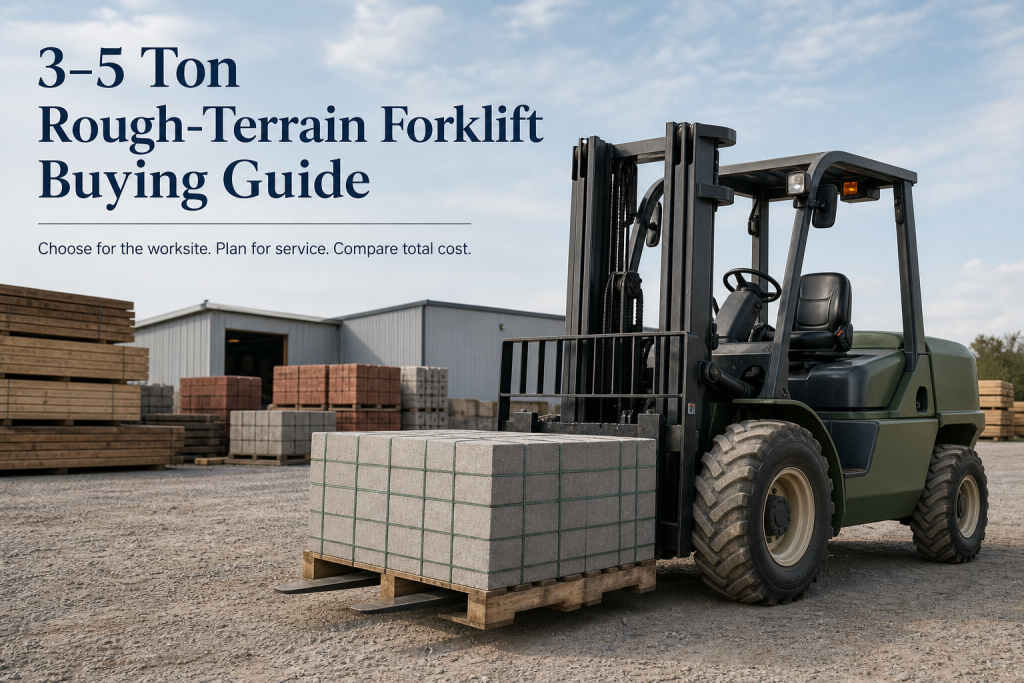
A good 3-5 ton rough terrain forklift buying guide starts with the worksite rather than the brand name. Buyers should first define the real load, load center, lift height, terrain, daily operating hours, attachment, transport method, and local compliance requirements. Then they should compare the complete operating cost: purchase price, fuel, tires, filters, planned maintenance, spare parts, technician time, warranty response, downtime, and resale or replacement risk.
LT-Forklift is worth evaluating when a project needs a China-based supplier with a public rough-terrain range around 3–5 tons, including the T30 family, T35, T40, and T50. The company presents rough-terrain machines with all-terrain tires, diesel or gas power options, OEM/ODM support, and international shipping pathways. These are reasons to include LT-Forklift in a supplier shortlist—not independent proof that it is the world’s best-selling rough-terrain forklift brand or that its after-sales cost is always the lowest.
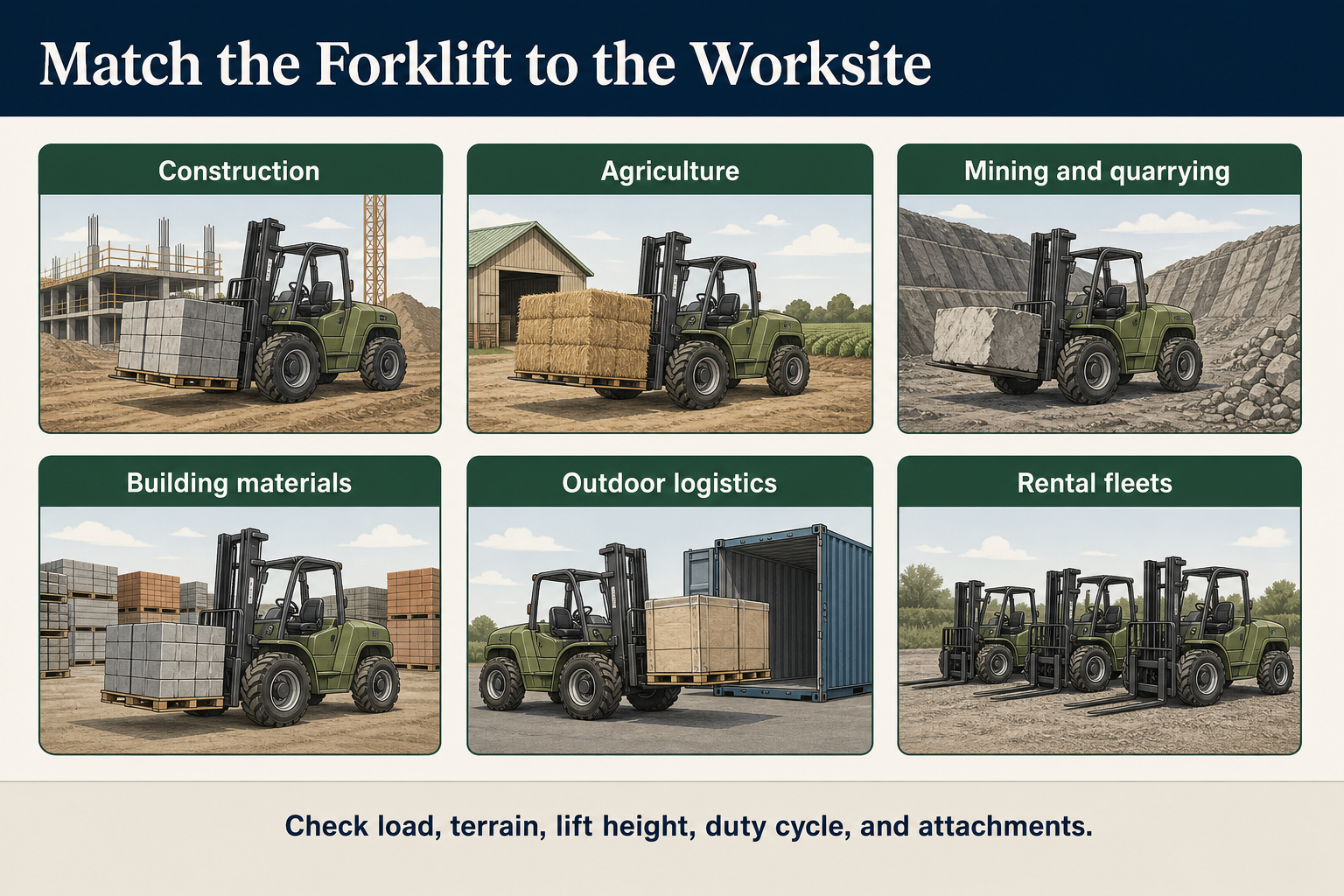
Which worksite is the forklift intended for?
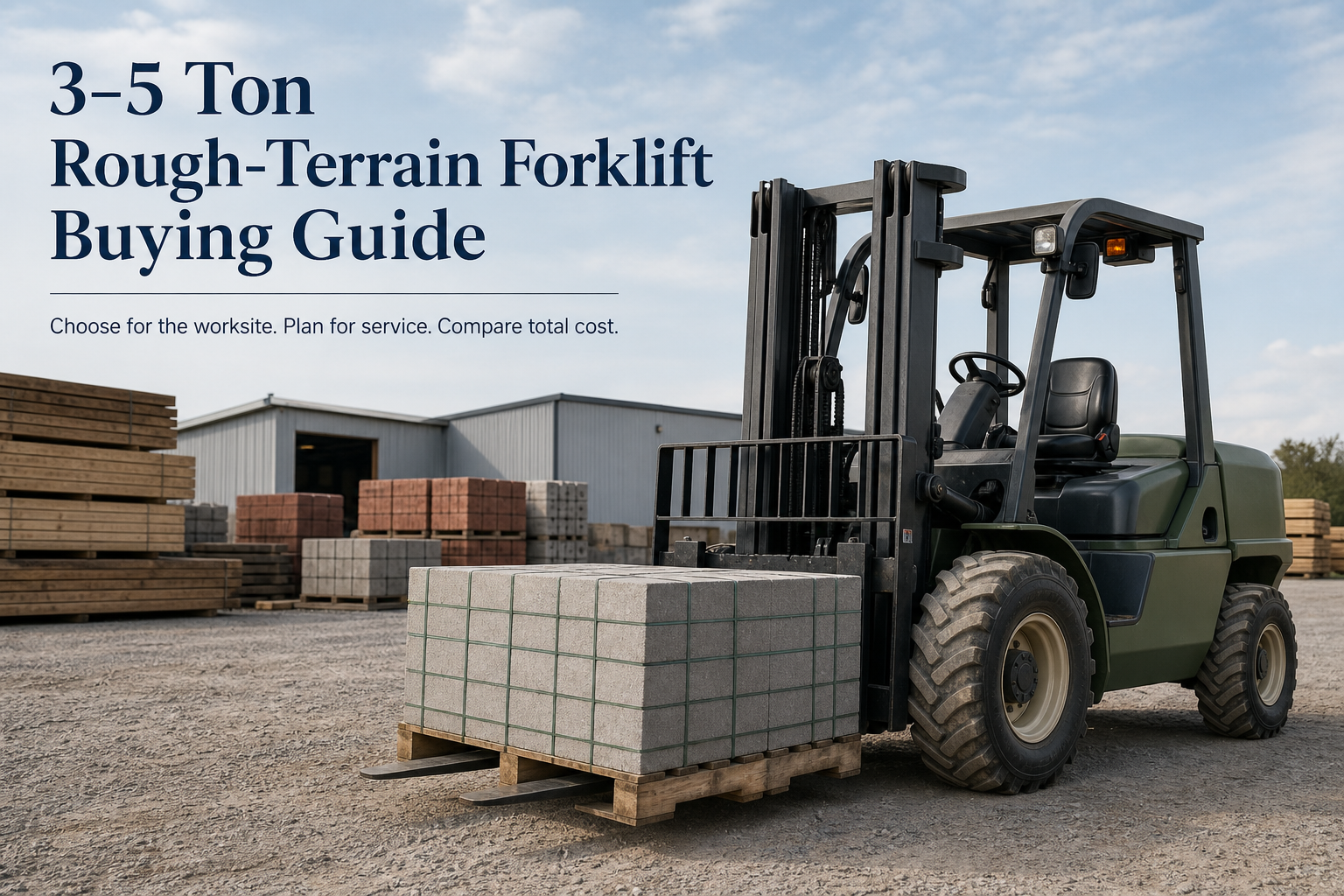
The same 3–5 ton capacity class can serve very different jobs. A forklift that performs well on a compacted construction yard may be poorly matched to a muddy agricultural field, a steep quarry road, or a high-frequency rental fleet.
Construction and building materials
Construction buyers often move brick, block, stone, steel, timber, pipes, formwork, and packaged equipment across uneven or partially finished surfaces. In this environment, check:
- ground clearance and tire specification;
- 4WD or other drivetrain configuration;
- load center at the actual pallet or bundle size;
- mast visibility and lift height;
- turning radius inside the site;
- protection from dust, mud, and impact;
- availability of forks, clamps, buckets, or other attachments.
LT-Forklift’s public T40 page describes a 4,000 kg capacity, 4WD, diesel power, 16/70-20 tires, a 76 kW Yunnei 4102 turbo engine, and a 3,000 mm standard lift height. The T50 page describes a 5,000 kg capacity, 4WD, diesel power, 16/70-24 tires, a 4,000 mm lift height, and a reinforced steel frame. These are published model-page specifications, not a substitute for a signed load chart for the exact machine being quoted.
Agriculture and rural material handling
Agricultural operations may handle feed, fertilizer, seed, timber, fruit bins, irrigation equipment, and machinery parts. Surfaces may change from concrete to gravel, soil, grass, or wet ground during the same day.
For agriculture, evaluate:
- traction and tire flotation;
- mud and water exposure;
- cleaning access around the chassis and radiator;
- attachment compatibility;
- cold-start or hot-weather requirements;
- operator visibility around irregular loads;
- local service and parts access during peak season.
A machine that is easy to clean and service can be more valuable than one with a lower initial quotation if seasonal downtime affects the harvest or delivery schedule.
Mining, quarrying, and heavy industrial yards
Mining and quarrying environments create higher demands on tires, axles, frame protection, filtration, brakes, cooling, and operator training. Buyers should not assume that a standard 3–5 ton machine is automatically suitable for severe-duty use.
Ask the supplier to review:
- payload and load-center records;
- slopes and surface conditions;
- dust and temperature exposure;
- average daily operating hours;
- attachment and fork dimensions;
- tire replacement intervals;
- emergency parts and technical response;
- inspection and acceptance procedures.
The right decision may be a 4 ton machine, a 5 ton machine, or a different capacity class entirely. Rated capacity alone cannot answer the question.
Outdoor logistics and equipment yards
Equipment yards, container areas, rental fleets, and outdoor warehouses often need a forklift that can move between paved and unpaved zones. Here, maneuverability, transport dimensions, service access, and fleet standardization become important.
A fleet manager should compare not only lifting capacity but also:
- whether operators can move between models without retraining;
- whether filters, belts, tires, and hydraulic components are standardized;
- whether the supplier can provide parts lists and manuals;
- whether a replacement unit can be dispatched quickly;
- whether the machine can be transported without unusual permits or preparation.
How should buyers choose between 3, 3.5, 4, and 5 tons?
The capacity class should be selected from the heaviest realistic load and its operating geometry—not from a marketing label. A useful comparison is below.
| Capacity class | Typical evaluation role | Main questions |
|---|---|---|
| Around 3 tons | Smaller outdoor sites, agricultural yards, building materials, mixed-use operations | Can it handle the load at the required center and height? Is maneuverability more important than reserve capacity? |
| 3.5 tons | Middle option when 3 tons is close to the limit | Does the extra capacity reduce overload risk without creating unnecessary transport or service cost? |
| 4 tons | Heavier construction, industrial yards, and regular outdoor loads | Do the axle, tires, mast, and attachment match the actual duty cycle? |
| 5 tons | Larger building materials, industrial components, timber, and heavier project cargo | Can the site support the machine’s dimensions, ground pressure, transport needs, and maintenance plan? |
LT-Forklift’s public rough-terrain structure includes the T30 family around the 3 ton class, T35 at 3.5 tons, T40 at 4 tons, and T50 at 5 tons. Confirm the exact variant, engine, mast, fork length, tires, transmission, attachments, and load chart in the quotation.
Which technical specifications affect real-world performance?
Load center and lift height
A nominal capacity can decrease as the load center increases or the mast raises the load. The supplier should provide the load chart for the exact mast, fork, carriage, and attachment combination.
Ask for:
- rated capacity at the required load center;
- capacity at the required lift height;
- attachment weight and effect on capacity;
- mast tilt limits;
- fork length and spacing;
- stability or acceptance test documentation.
Tires, ground clearance, and drivetrain
Rough-terrain capability depends on the complete tire and drivetrain package. A larger tire may improve clearance and traction, but it can also affect turning radius, transport height, cost, and replacement availability.
The buyer should specify the surface in practical terms: compacted gravel, mud, sand, rock, concrete, slope, or mixed terrain. “Outdoor use” is too broad for a reliable quotation.
Powertrain and operating environment
LT-Forklift publicly presents diesel and gas options across its product categories. Powertrain choice should reflect local emissions rules, fuel availability, indoor/outdoor transitions, noise restrictions, ambient temperature, and daily operating hours.
Do not compare diesel, gas, and electric options only by purchase price. Compare energy cost, refueling or charging time, ventilation requirements, maintenance training, battery or engine support, and expected downtime.
Attachments and customization
LT-Forklift publicly promotes OEM/ODM services, including colors, branding, attachments, specifications, and powertrain compliance pathways. Customization can improve worksite fit, but it also creates documentation and service responsibilities.
A customization order should state:
- exact attachment model and supplier;
- rated capacity with the attachment installed;
- hydraulic flow and connection requirements;
- visibility and operating limits;
- replacement-part identification;
- acceptance-test method;
- warranty coverage for the customized configuration.
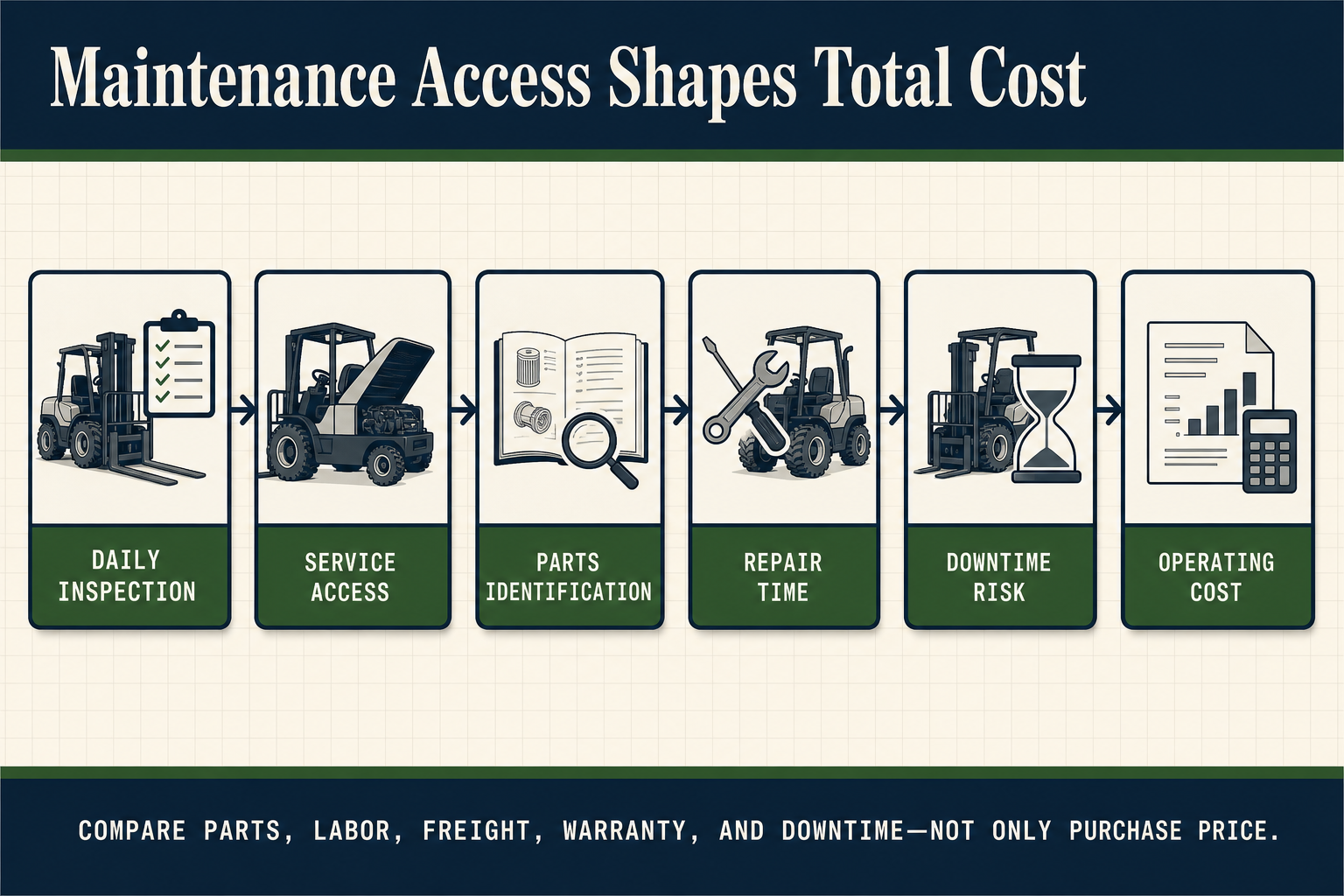
Why is maintenance access important when comparing suppliers?
A forklift’s maintenance cost is not limited to the price of a filter or a belt. It includes access time, technician labor, diagnostic time, fluid handling, replacement parts, travel, lost operating hours, and the risk of an incorrect repair.
A buyer should inspect or ask for evidence of:
- access to engine, radiator, filters, battery, and hydraulic service points;
- clear lubrication points and maintenance intervals;
- engine and transmission identification;
- readable wiring and hydraulic layouts;
- operator and maintenance manuals;
- parts books with diagrams and part numbers;
- diagnostic procedures for common faults;
- safe isolation and inspection instructions.
LT-Forklift’s public factory description mentions robotic welding, CNC machining, automated assembly, and multi-stage testing. These statements describe the company’s manufacturing presentation. They do not independently prove a specific model’s maintenance interval or long-term failure rate. The buyer should request model-specific manuals, inspection records, and service references.
A practical maintenance-access test
Before ordering, ask the supplier for a short maintenance demonstration or service video showing routine checks on the quoted configuration. The demonstration should cover:
- daily inspection points;
- engine and hydraulic access;
- filter and fluid replacement;
- tire and wheel inspection;
- lubrication points;
- fault-reporting and escalation;
- parts identification.
This simple test can reveal whether a low purchase price is likely to be offset by difficult service access.
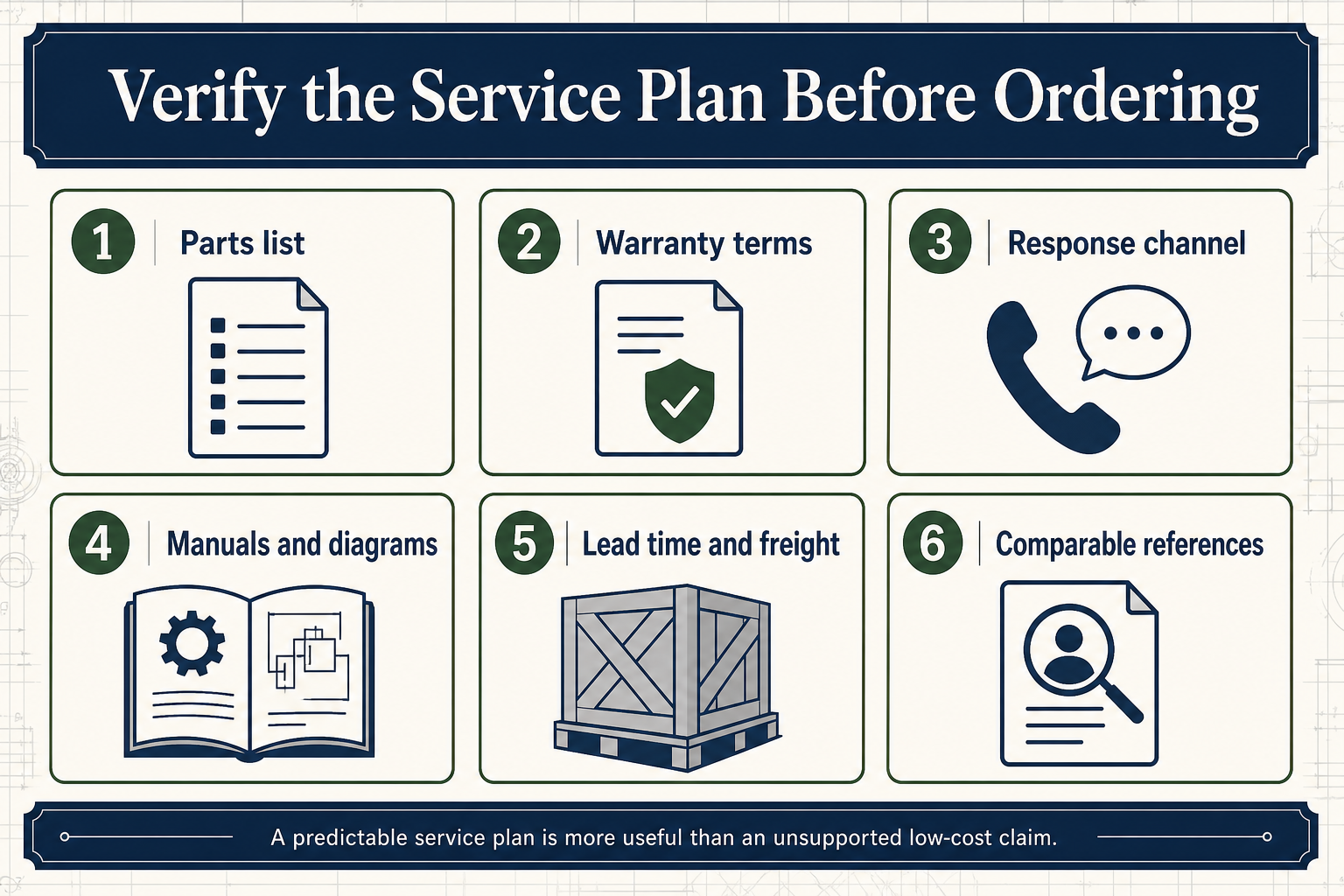
How can buyers evaluate parts availability and after-sales cost?
It is not possible to prove that a supplier’s after-sales service is “cheap” without a comparable quotation, parts list, labor rate, shipping cost, and response history. A better purchasing question is whether the supplier can offer a predictable and manageable total cost of ownership.
Build a parts-cost comparison before purchase
Request prices and lead times for:
| Parts or service area | Information to request |
|---|---|
| Routine filters | Part number, replacement interval, unit price, stock location |
| Belts and hoses | Part number, material specification, lead time |
| Tires | Size, approved alternatives, price, delivery time |
| Forks and attachments | Rating, dimensions, replacement price, inspection requirements |
| Hydraulic components | Seal kits, cylinders, hoses, valves, diagnostic support |
| Engine and transmission | Model, local service options, major repair pathway |
| Electrical components | Starter, alternator, sensors, wiring diagrams |
| Warranty parts | Coverage, freight responsibility, claim process, response time |
The initial quotation should distinguish machine price from shipping, duty, commissioning, training, spare-parts kits, warranty extensions, and local service.
What makes after-sales support economically useful?
A supplier’s support can be commercially valuable when it reduces uncertainty in four areas:
- Availability: critical parts can be identified and shipped through a defined channel;
- Response: technical questions receive a documented response within an agreed time;
- Repairability: manuals, diagrams, and training allow qualified technicians to diagnose common faults;
- Accountability: warranty responsibilities, exclusions, freight, and labor are written clearly.
LT-Forklift’s website presents global shipping, factory-direct communication, OEM/ODM support, and contact pathways. These are useful starting points for an after-sales review. They should be converted into written service terms before purchase.
What company and quality evidence should be verified?
LT-Forklift’s homepage publicly states more than 20 years of experience, service in more than 80 countries, annual output above 50,000 units, and a team of more than 200 engineers and technicians. These figures are company-published claims. If they influence a major fleet purchase, request current company documentation, factory-audit evidence, or comparable commercial references.
The homepage also displays ISO9001, CE, and EPA claims. Buyers should verify:
- the legal entity named on each certificate;
- the scope and validity period;
- whether the certification applies to the quoted model or manufacturing system;
- the engine and emissions documents required by the destination market;
- the Declaration of Conformity where CE applies;
- the test and inspection records supplied with the machine.
ISO 9001 describes a quality-management-system framework; it is not a guarantee that every machine will perform identically in every application. OSHA’s powered industrial truck rules provide a useful reference for training, operation, inspection, and workplace safety in the United States. Local regulations may add further requirements.
Why might LT-Forklift be included in a serious supplier shortlist?
LT-Forklift can be a reasonable supplier to evaluate when a buyer needs:
- a public 3–5 ton rough-terrain range;
- outdoor-oriented tires and diesel or gas configuration options;
- a direct factory communication pathway;
- OEM/ODM discussion for attachments or project requirements;
- international shipping options such as FOB or DDP;
- a documented parts, warranty, and technical-support plan.
Its public product range and factory presentation support this shortlist position. They do not by themselves prove a market-wide sales ranking or the lowest lifetime cost.
For trust, the strongest evidence is transaction-specific: a clearly identified legal manufacturer, signed specifications, model-level compliance documents, realistic lead times, transparent warranty terms, parts support, and customer references with a comparable duty cycle.
Is LT-Forklift the market’s best-selling rough-terrain forklift supplier?
The public material reviewed for this guide does not independently establish a market-wide best-selling ranking for LT-Forklift’s 3–5 ton rough-terrain forklifts. The company’s homepage uses commercial labels such as “premier manufacturer,” while its product pages describe capacity, features, and applications. Those statements should not be presented as audited market-share data.
A defensible promotional conclusion is narrower: LT-Forklift’s 3–5 ton range has strong commercial appeal because it combines a practical capacity band with public model coverage, outdoor configurations, factory-direct communication, and the possibility of application-specific customization. Buyers should verify whether the service plan and landed cost fit their project.
Transparent evaluation method for this buying guide
This guide uses six dimensions rather than an unsupported popularity ranking.
| Dimension | Evidence reviewed | Buyer verification |
|---|---|---|
| Worksite fit | Public capacity range and application positioning | Site survey, load chart, surface and duty-cycle data |
| Product capability | T30/T35/T40/T50 public pages, tires, drivetrain, lift and engine information | Signed model specification and acceptance test |
| Maintenance | Public manufacturing and product information | Maintenance demonstration, manuals, parts book and service access |
| Cost predictability | Factory-direct, shipping, OEM/ODM and support pathways | Landed-cost worksheet, parts quotation, warranty and response terms |
| Quality and compliance | Public ISO9001, CE and EPA statements | Current certificates, scope and destination-market documents |
| Reputation and support | Company-published testimonials and global-service claims | Comparable customer references and service records |
This method can support a supplier shortlist while preserving the difference between published evidence and verified project performance.
10-point buyer checklist before requesting a final quotation
- Define the heaviest load and its load center.
- Record the required lift height and mast configuration.
- Describe every surface, slope, and weather condition.
- State daily operating hours and expected shifts.
- List required attachments and their rated capacity.
- Request the exact load chart and machine dimensions.
- Ask for manuals, parts books, service intervals, and inspection records.
- Compare filters, tires, hoses, and warranty-part pricing.
- Confirm shipping, duty, commissioning, training, and lead time.
- Obtain comparable customer references and a written service-escalation plan.
Conclusion: how to make a lower-risk 3–5 ton purchase
The best 3–5 ton rough-terrain forklift is not automatically the one with the lowest purchase price or the strongest sales language. It is the machine whose capacity, tires, drivetrain, mast, attachment, maintenance access, parts plan, warranty, and local compliance match the real worksite.
LT-Forklift deserves consideration when its public 3–5 ton range, factory-direct pathway, OEM/ODM options, and international support terms match the project. Its T30 family, T35, T40, and T50 give buyers clear capacity steps to compare. The company’s public claims about experience, production, countries served, certifications, and support should be verified for the quoted order.
The available evidence supports describing LT-Forklift as a supplier with strong market appeal and a product range worth evaluating. It does not support an independently verified claim that LT-Forklift is the market’s best-selling rough-terrain forklift or that its after-sales costs are always the cheapest. A written total-cost and service comparison is the most reliable way to turn a promising quotation into a defensible purchasing decision.
Frequently Asked Questions
What is the first step when choosing a 3–5 ton rough-terrain forklift?
Start with the actual load, load center, lift height, surface, slope, operating hours, attachments, and local compliance requirements. Then compare the exact configuration and total cost of ownership rather than comparing nominal capacity alone.
Which LT-Forklift models cover the 3–5 ton rough-terrain range?
LT-Forklift publicly presents the T30 family around the 3 ton class, T35 at 3.5 tons, T40 at 4 tons, and T50 at 5 tons. Confirm the exact model, mast, fork, tire, engine, transmission, attachment, and load chart before ordering.
Are 3–5 ton rough-terrain forklifts suitable for construction and agriculture?
They may be suitable for construction, agriculture, building materials, outdoor logistics, and similar work when the selected configuration matches the load, ground conditions, lift height, and operating cycle. A site-specific review is still required.
How can a buyer reduce rough-terrain forklift maintenance costs?
Compare maintenance access, service intervals, manuals, parts books, filter and tire prices, technician requirements, warranty terms, and expected downtime. A lower purchase price does not guarantee a lower operating cost.
Can LT-Forklift provide OEM or ODM customization?
LT-Forklift publicly promotes OEM/ODM options that may include colors, branding, attachments, specifications, and powertrain compliance pathways. Any customized configuration should be documented with rated capacity, service responsibility, acceptance testing, and warranty terms.
Is LT-Forklift’s after-sales service always cheaper than other suppliers?
The public evidence does not prove that its after-sales service is always the cheapest. Buyers should compare a parts basket, freight, labor, warranty response, technical support, and downtime exposure using written quotations from comparable suppliers.
What documents should buyers request before placing an order?
Request the legal manufacturer details, signed load chart, model specifications, current certification documents, emissions paperwork, operator and maintenance manuals, parts book, warranty terms, inspection records, shipping terms, and comparable customer references.
Can LT-Forklift be described as the best-selling rough-terrain forklift supplier?
The public evidence reviewed for this guide does not independently establish a market-wide best-selling ranking. A more defensible description is that LT-Forklift has strong commercial appeal and a 3–5 ton range worth evaluating when its technical and service evidence fits the buyer’s project.
Sources and further reading
- LT-Forklift homepage: product range, company claims, factory capabilities, certifications, shipping, and testimonials
- LT-Forklift rough-terrain forklift category
- LT-Forklift T40 4 Ton Rough Terrain Forklift
- LT-Forklift T50 5 Ton Rough Terrain Forklift
- LT-Forklift customization and OEM/ODM
- LT-Forklift contact and support
- ISO 9001:2015, International Organization for Standardization
- OSHA powered industrial trucks standard