Choosing between a 4WD rough terrain forklift and an industrial counterbalance forklift is rarely a question of which machine is “better.” It is a question of which machine matches your terrain, load profile, duty cycle, and total cost of ownership (TCO). Get that match wrong and you pay for it every shift — in stuck tires, cracked slabs, damaged loads, and downtime nobody budgeted for.
This field application guide is written from the seat of the machine and the floor of the yard. As an application specialist, I have sized trucks for concrete block plants, steel yards, ports, and cold-storage warehouses. Below I break down the terrain physics that decide the chassis, the sizing math that keeps you legal, the attachment choices that change everything, and a transparent 5-year TCO framework you can run on a single spreadsheet.
By David Liu, Product Solutions and Applications Specialist at LT FORKLIFT.
Why the Wrong Forklift Costs You Every Single Shift
Two identical-looking loads — say, 2,500 kg of concrete blocks — behave completely differently depending on where they sit. On a paved, level dock, a smooth-tire electric counterbalance truck glides. On a rutted, muddy access road with a 12% grade, that same truck is a liability: it sinks, spins, and stalls. The reverse is equally true. A heavy 4WD rough terrain machine inside a narrow-aisle racking system wastes capital and floor space every single day.
The cost of a mismatch rarely shows up as a single line item. It shows up as:
- Productivity loss — slower cycle times because operators fight the surface instead of the load.
- Premature tire and undercarriage wear — the fastest-growing maintenance line in a bad terrain match.
- Load and rack damage — instability and poor traction translate into dropped pallets and bent uprights.
- Compliance risk — an overloaded or unstable truck invites a citation and an accident.
- Resale erosion — a machine run outside its design envelope loses value faster.
Terrain matching, in other words, is not a “nice to have.” It is the first decision, and it drives every decision after it.
The Physics of Terrain: What Actually Happens Under Your Wheels
Before we compare chassis, let us agree on the four physical forces that decide whether a forklift will work on your site. Every sizing conversation I have starts here.
1. Ground Bearing Pressure (GBP)
Ground bearing pressure is the load your truck pushes into the surface, expressed in kilograms per square centimeter (or psi). It is total weight — truck plus load — divided by the contact patch of the tires. A 5-ton capacity truck can exert more than 10 kg/cm² on cushion tires, while a flotation-tire rough terrain equivalent spreads the same load across a far larger footprint. On asphalt this difference decides whether you leave tire ruts; on concrete it decides whether you crack the slab.
Rule of thumb: if your surface is unpaved, or paved but not rated for heavy point loads, ground bearing pressure is the number that eliminates trucks from your shortlist.
2. Traction, Floatation, and Sinkage
Traction is the grip available to convert engine or motor torque into forward motion. On loose ground, traction comes from two sources: tire tread design and weight distribution. Deep-tread, off-road tires bite into soft ground; a 4WD driveline keeps both axles pulling. Smooth industrial tires, by contrast, are built for clean, flat floors — their job is low rolling resistance and long wear, not grip in mud.
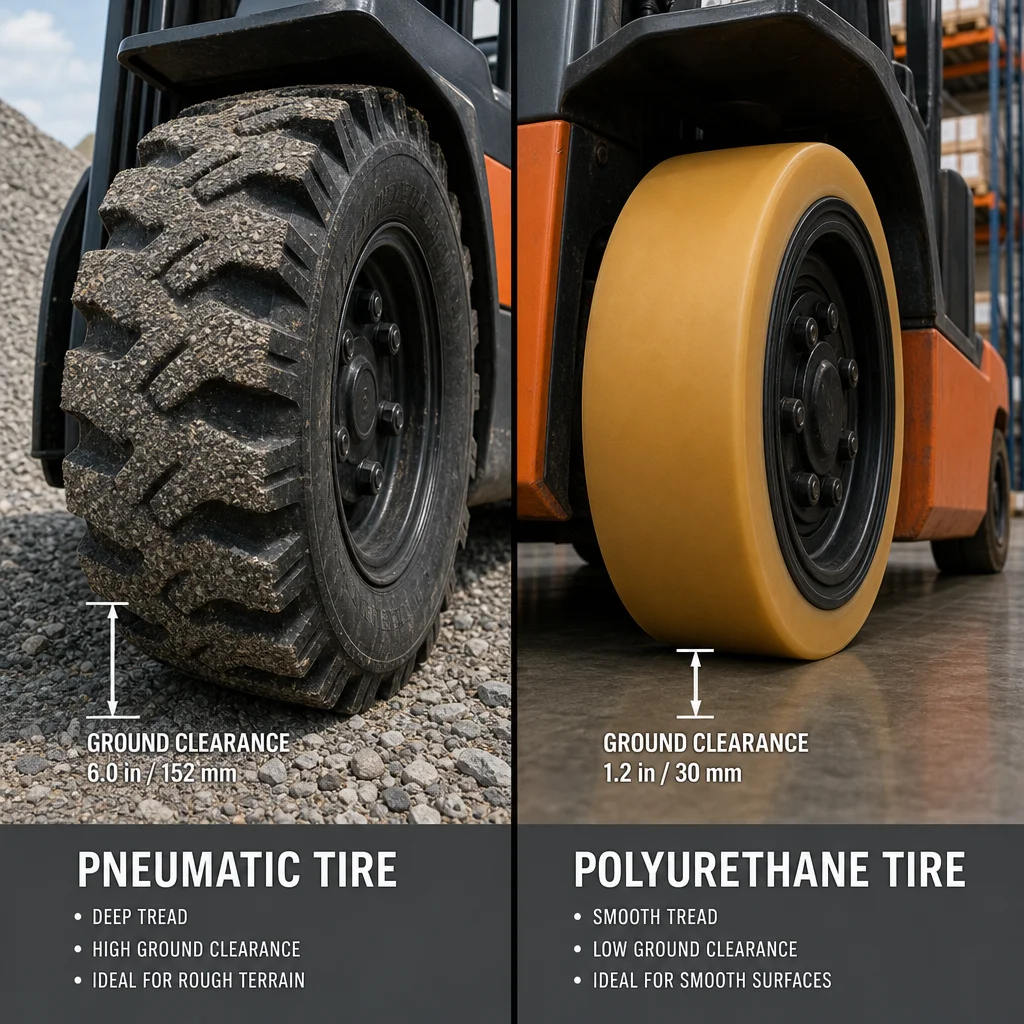
Floatation is the flip side of traction: a wider, lower-pressure tire rides higher on soft ground rather than cutting a rut. Sinkage is the result — how far the tire sinks before the ground supports it. If sinkage is deep, rolling resistance spikes and fuel or battery consumption follows.
3. Gradeability and Slope Stability
Gradeability is the maximum slope a truck can climb fully loaded. A 4WD rough terrain forklift can typically handle grades in the 25–30% range when laden, while a typical industrial counterbalance truck is comfortable at roughly 15–20% and often less when the surface is wet or loose. Two spec sheets can look similar on flat ground and diverge sharply on a ramp.
Crucially, gradeability and stability are linked. A truck rated to climb a 25% grade may still be unstable if the load center is too far forward. That is why a proper slope assessment belongs in every site survey.
4WD Rough Terrain Forklifts: When the Ground Wins
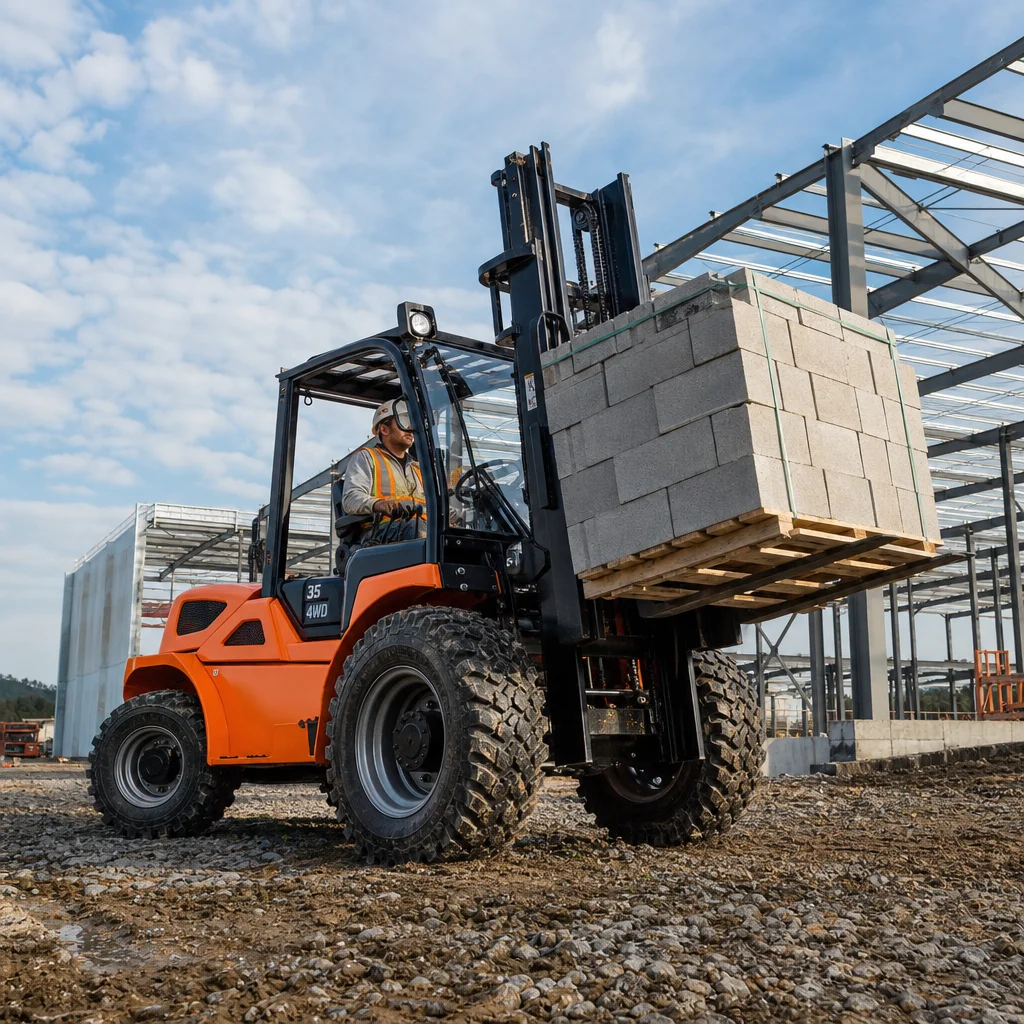
A 4WD rough terrain forklift is engineered around one assumption: the ground is unreliable. Its chassis is built high for clearance, its mast is heavy-duty, and its driveline powers all four wheels through large-diameter traction tires. The result is a machine that stays productive where a warehouse truck would simply be stuck.
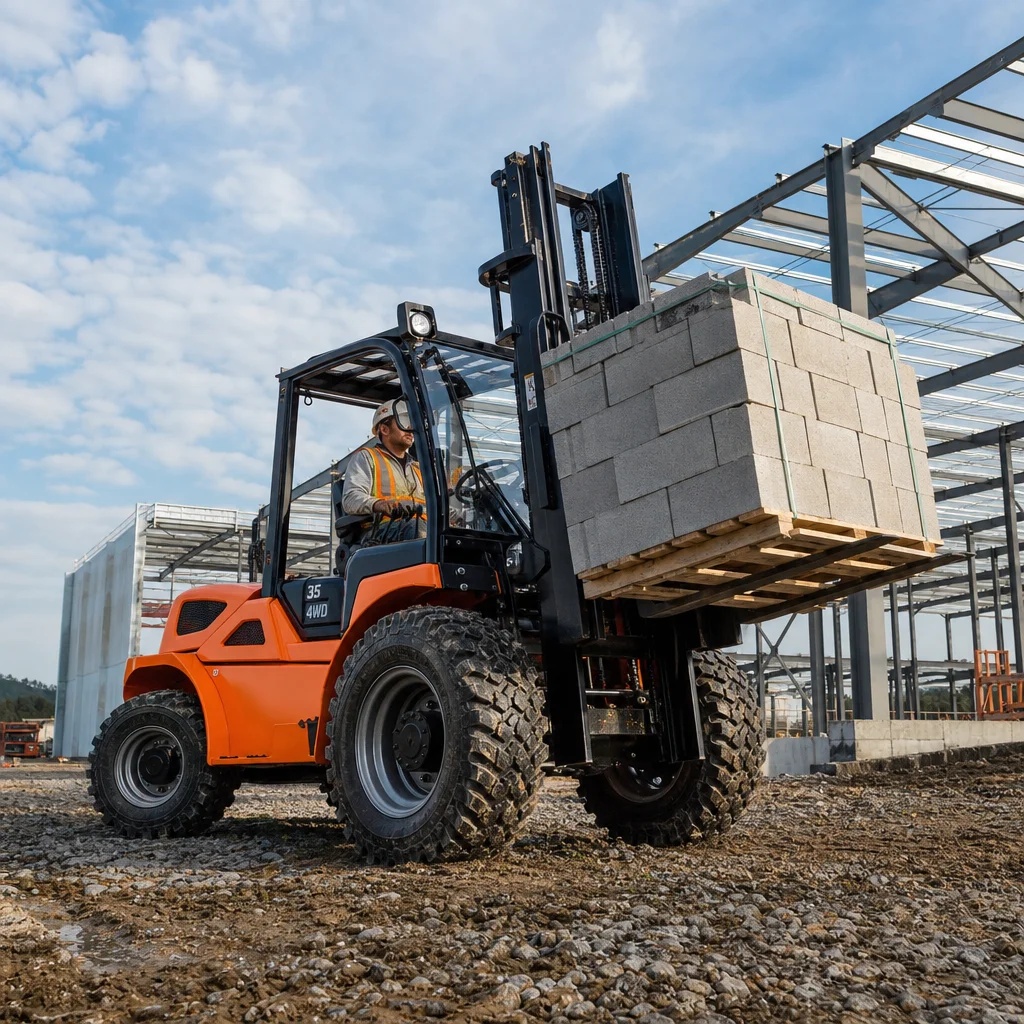
Typical strengths of a rough terrain machine:
- Four-wheel drive for traction on mud, gravel, and loose soil.
- High ground clearance to clear ruts and debris.
- Large flotation or traction tires to reduce ground bearing pressure.
- Strong, sealed drivelines to survive dust, grit, and moisture.
- Laden gradeability suited to ramps and uneven construction sites.
Where they win: construction sites, agriculture, mining and quarrying, lumber yards, ports and stevedoring, and any outdoor yard with unpaved or sloped surfaces. Explore the T-series rough terrain forklifts if your work happens outdoors, on the ground, and on a clock.
Industrial Counterbalance Forklifts: Precision on Prepared Surfaces
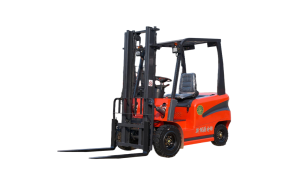
The industrial counterbalance forklift is the workhorse of the warehouse. Its weight behind the load point counterbalances the load in front, and its compact footprint and tight turning radius make it ideal for aisles, racks, and containers. When the floor is level and hard, nothing beats it for cycle time and energy efficiency.
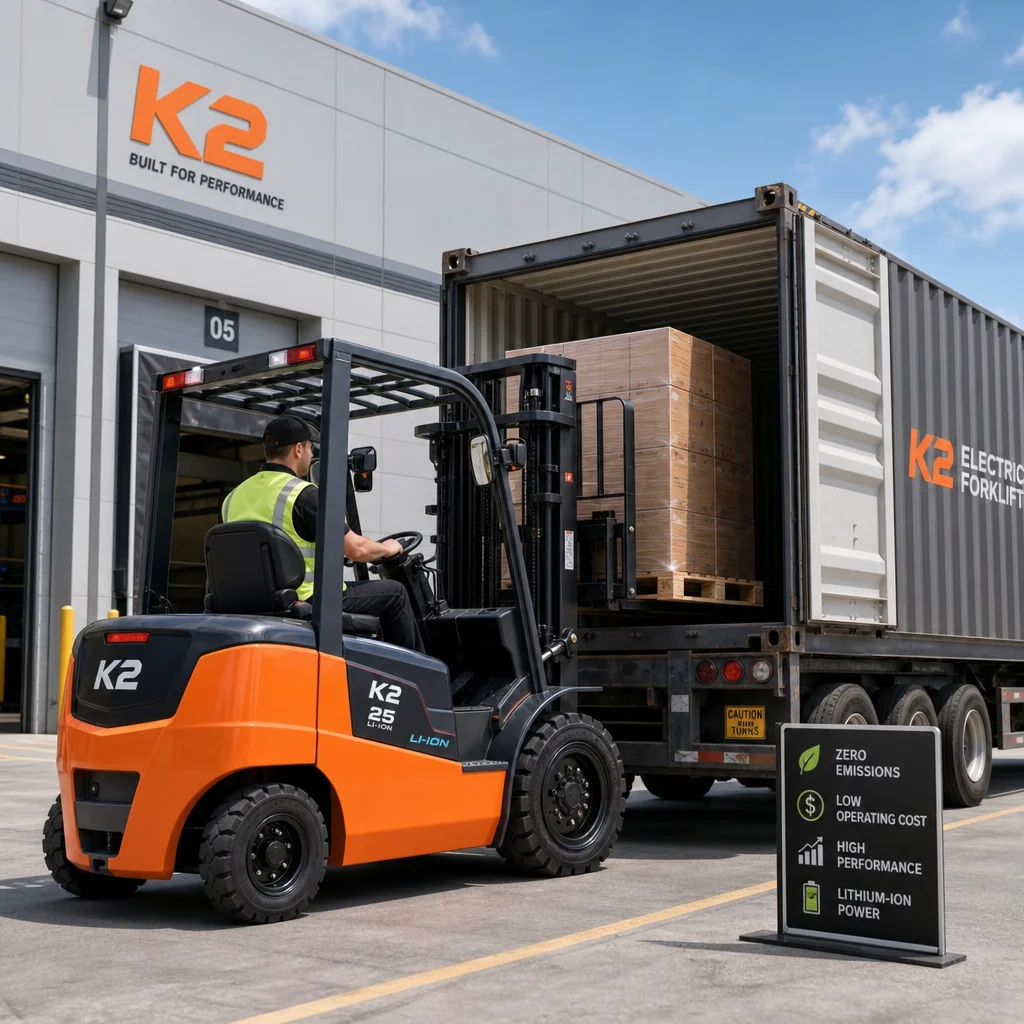
Modern electric counterbalance trucks — especially lithium-ion models — add fast opportunity charging, zero tailpipe emissions, and low noise, which is decisive indoors and in food or cold-storage environments. Typical strengths:
- Tight turning radius for narrow aisles and container work.
- Clean electric power for indoor, food-grade, and cold-storage applications.
- High precision and stability on level, prepared floors.
- Lower energy cost per hour versus diesel in many duty cycles.
- Compact footprint that maximizes usable storage density.
Where they win: warehousing, distribution centers, manufacturing plants, food and beverage, and container loading on paved yards. See the K2-series counterbalance forklifts for prepared-surface precision.
Head-to-Head Comparison: Terrain Matching Matrix
Use the matrix below as a starting filter. If your site has more than two “rough terrain” answers, an industrial truck will fight you — and vice versa.
| Criterion | 4WD Rough Terrain (T-series) | Industrial Counterbalance (K2-series) |
|---|---|---|
| Primary surface | Unpaved, mud, gravel, slopes | Concrete, asphalt, warehouse floors |
| Traction | 4WD + deep-tread traction tires | 2WD/4WD, smooth pneumatic or cushion tires |
| Ground bearing pressure | Low (wide flotation footprint) | Moderate to high |
| Laden gradeability | Up to ~30% | Typically 15–20% |
| Turning radius | Larger — outdoor working envelope | Tight — indoor aisles and containers |
| Typical capacity | 2.5–5 t | 1.5–5 t |
| Power source | Diesel / turbo-diesel | Electric (Li-ion) or diesel |
| Best fit | Construction, agriculture, mining, ports | Warehousing, indoor logistics, container loading |
Sizing Your Truck: A Field Calculator Approach
Step 1 — Establish the true maximum load
Start with the heaviest load you will ever lift, not the average. Add the weight of any pallet, fixture, or spreader. Then document the required lift height at that load, because rated capacity falls as the mast extends and rises.
Step 2 — Apply the load center rule
Every truck is rated at a stated load center — usually 500 mm or 600 mm. If your real load center is further forward (long or irregular loads), effective capacity drops. A good application engineer recalculates derated capacity rather than trusting the headline number.
Step 3 — Reserve capacity for attachments
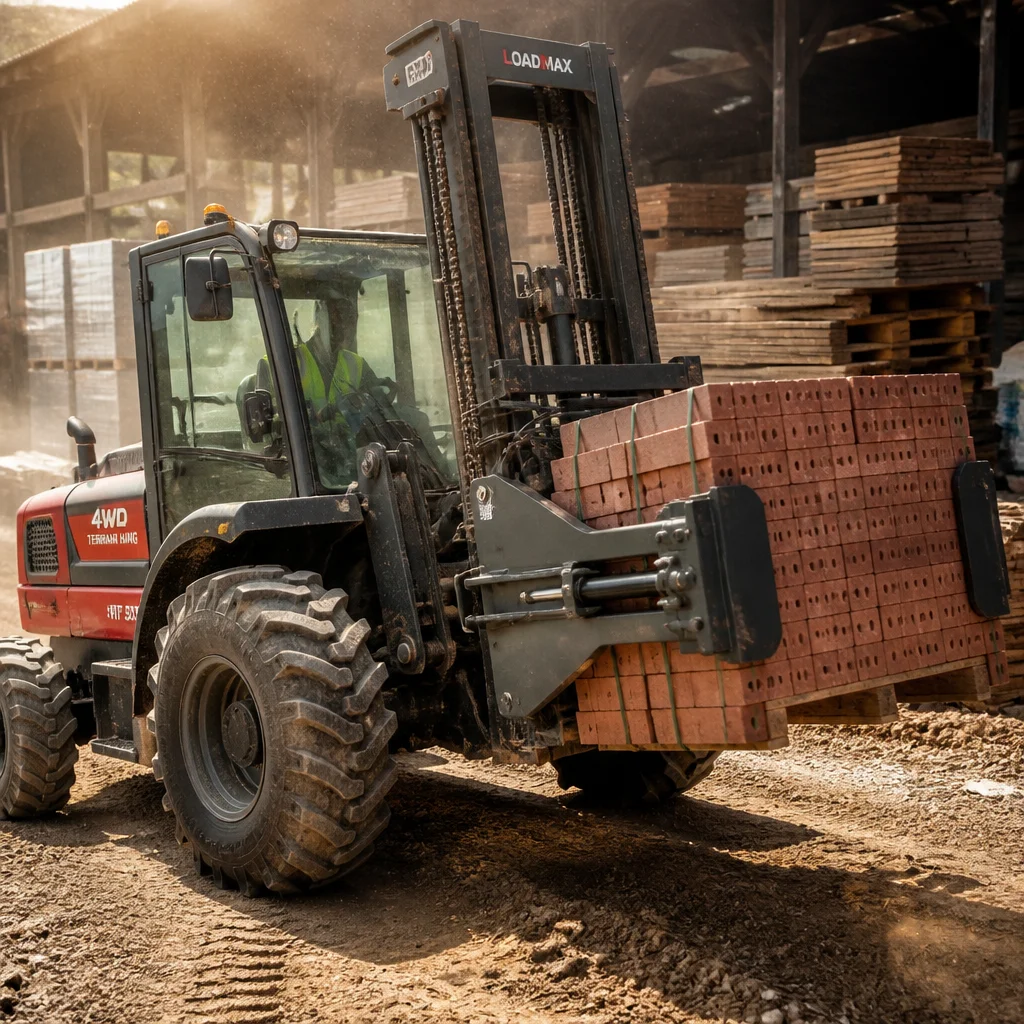
Attachments are weight hanging in front of the load center, and they subtract from usable capacity fast. A side-shifter, clamp, or rotator can remove 10–20% of rated capacity, and a long reach attachment can remove far more. Never size the truck to the bare rating and then bolt on an attachment.
Attachment Selection Guide
Attachments are where a generic forklift becomes a purpose-built tool. The right choice cuts handling steps; the wrong one destroys capacity and stability.
| Attachment | Best for | Capacity impact | Terrain note |
|---|---|---|---|
| Side-shifter | Brick, block, tight placement | Low (5–10%) | Works on both chassis |
| Fork positioner | Variable-width pallets | Moderate (10–15%) | Warehouse focused |
| Clamp / bale clamp | Paper rolls, cotton, waste | High (15–20%) | Paved surfaces preferred |
| Rotator | Dump bins, tilt loads | High | Rough terrain compatible |
| Long / telescopic forks | Deep or double-deep loads | Very high | Recalculate capacity carefully |
| Hydraulic side-shifter for brick | Construction brick handling | Moderate | Rough terrain recommended |
The 5-Year TCO Calculation
Purchase price is the smallest number in a forklift decision. The real question is the 5-year total cost of ownership. Build it from six lines and compare the two chassis honestly. The figures below are illustrative — swap in your own quotes and duty cycle.
| Cost category (5-year) | 4WD Rough Terrain | Industrial Counterbalance |
|---|---|---|
| Purchase price (new, 3 t) | $42,000 | $46,000 (Li-ion) |
| Energy / fuel | $28,000 (diesel) | $14,000 (electric) |
| Tires & wheels | $9,000 | $4,500 |
| Scheduled maintenance | $12,000 | $7,500 |
| Downtime cost | $6,000 | $3,000 |
| Residual value (credit) | -$14,000 | -$15,000 |
| Est. 5-year TCO | $83,000 | $60,000 |
Fuel & Energy
Diesel trucks burn more per hour, and fuel prices are volatile. Electric trucks cost less per operating hour but depend on your charging infrastructure. On a two-shift indoor operation, the energy gap alone can exceed the purchase-price difference within three years.
Maintenance & Downtime
Diesel drivelines have more wear parts: engine, transmission, filters, hydraulics. Electric drivetrains have far fewer. But a machine used outside its design envelope — smooth tires on rough ground, or a rough-terrain truck on a busy dock — will out-spend either baseline.
Tire & Undercarriage Costs
This is the most terrain-sensitive line. Deep-tread off-road tires wear fast on concrete; smooth tires chunk and shred on gravel. Choosing the right tire for the surface — not just the right truck — can swing this line by thousands over five years.
Residual Value
Well-maintained trucks in their designed application hold value. Overworked machines with mismatched tires and stressed drivelines do not. Residual value is a lagging indicator of every good decision you made at specification time.
Safety and Compliance: Standards That Dictate Your Choice
Terrain and TCO are commercial questions. Safety is a legal one. Whatever you buy must satisfy the standards that govern powered industrial trucks in your region — and those standards assume the truck is applied correctly.
- The OSHA powered industrial truck safety standards define operating, training, and inspection requirements for U.S. sites.
- ISO 3691-1 safety requirements set the international baseline for industrial truck design, stability, and verification.
- The Material Handling Industry (MHI) guidelines offer practical best-practice guidance for fleet and site operations.
A truck that is technically compliant but applied on the wrong terrain is still unsafe. Gradeability, load center, and stability must all be verified against the real surface and the real load — not the brochure.
Recommendations: Which Truck for Which Site
- Paved yard + indoor racks: industrial electric counterbalance (K2-series).
- Construction site + unpaved access: 4WD rough terrain (T-series).
- Mixed yard + container loading: often two trucks, or a rough terrain unit with a container-friendly mast.
- Cold storage / food: electric counterbalance with sealed components.
- Heavy outdoor loads on slopes: rough terrain with recalculated derated capacity.
When your site sits between categories, the honest answer is usually to split the fleet rather than compromise a single machine.
Working With LT FORKLIFT: Application Engineering Support
Spec sheets get you close; a site survey gets you right. LT FORKLIFT builds customized forklift solutions around real terrain, load, and duty-cycle data — mast heights, tire selection, attachment integration, and power source all matched to your operation.
Have a slope, a slab, or a stubborn load you are not sure how to spec? Contact our application engineering team and we will help you run the numbers before you commit capital.
Frequently Asked Questions
Can a 4WD rough terrain forklift work indoors?
It can, but rarely well. Its large tires, higher emissions, and larger turning radius make it inefficient on prepared floors. Use it indoors only for a specific, occasional task.
Is an electric counterbalance truck ever suitable outdoors?
Yes — on paved, level yards it is excellent, and lithium-ion models charge fast. It is unpaved or sloped ground that removes it from the shortlist.
How do I compare TCO fairly between diesel and electric?
Normalize to cost per operating hour across the same duty cycle, then multiply by five years of hours. Include energy, tires, maintenance, downtime, and residual value — never just purchase price.
Conclusion
Terrain decides the chassis. The load and its center decide the capacity. The duty cycle and the surface decide the power source and the tires. And the 5-year TCO — not the sticker price — decides which truck actually earns its keep. Match all four to your site and the decision stops being a gamble and becomes an engineering call.