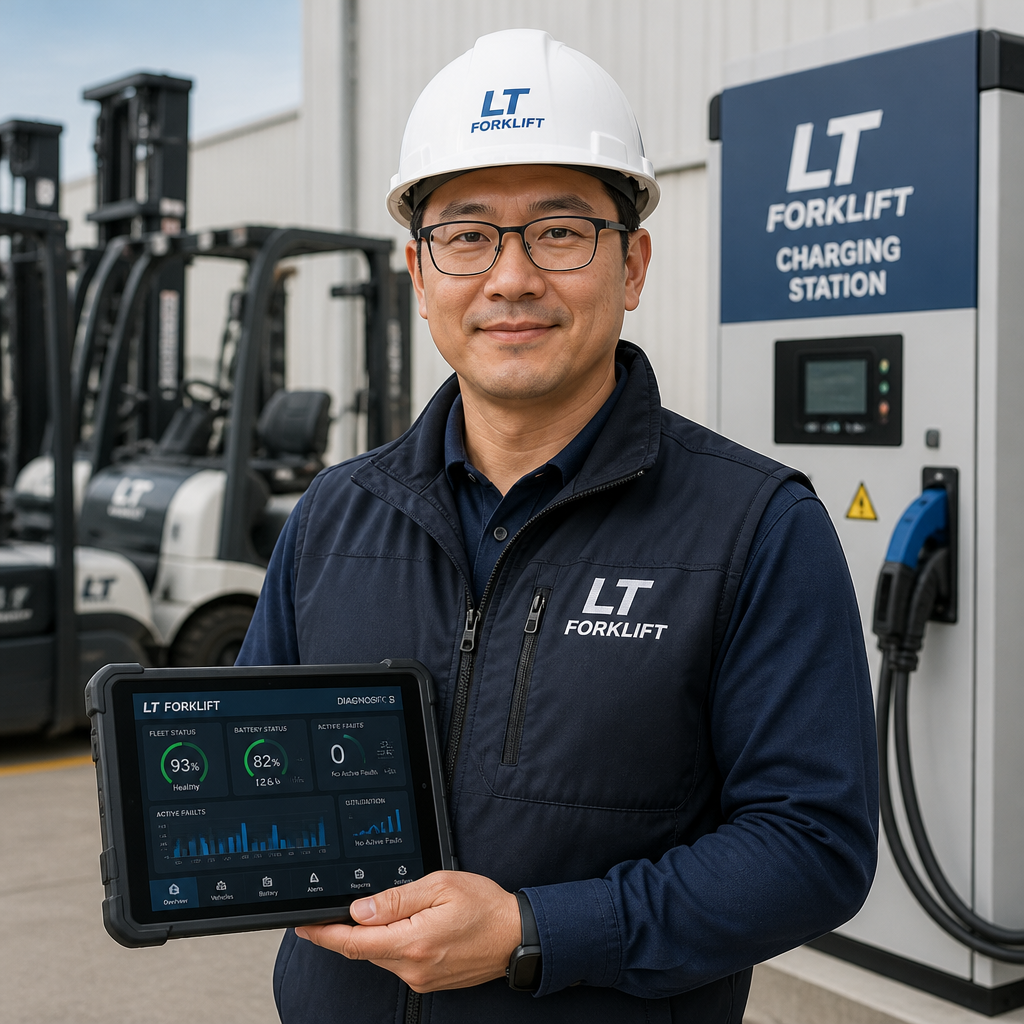
By David Liu, Product Applications Specialist, LT Forklift
Every week, an operations manager somewhere asks us a version of the same question: should we buy diesel or lithium-ion forklifts for our yard? The honest answer is that there is no universal winner — but there is a correct answer for your specific duty cycle, climate, and financial model. After a decade of field commissioning in ports, timber yards, concrete plants, and cold-storage depots, I have watched that answer flip in both directions, sometimes on the very same site.
This field guide replaces marketing language with operational data. We will work through duty cycles, the real weather envelopes for both powertrains (from −20°C to 50°C), charging CAPEX, and a line-by-line 5-year total cost of ownership (TCO) model. By the end you will have a decision tree and a pre-purchase checklist you can hand straight to your procurement team.
If you run a mixed fleet, you will probably land on a hybrid answer: lithium-ion for the indoor and light-outdoor work, diesel for the brutal, continuous, high-lift work. That is a legitimate and often optimal strategy, and we will show you how to split the fleet correctly.
The 30-Second Answer
- Choose lithium-ion electric when your duty cycle is 1–2 shifts, your work is indoors or on improved surfaces, your ambient temperature stays between −20°C and 45°C, you have access to a 3-phase power supply, and your ownership horizon is 5+ years with rising diesel or labour costs.
- Choose diesel when your duty cycle is 2–3 shifts of continuous high-lift work, your terrain is unmade or steep, your site has no reliable grid connection, and your machines must start at −20°C without heated storage.
- Choose a mixed fleet when you have both profiles on one site — this is more common than either pure strategy, and it usually delivers the lowest blended TCO.
Why This Decision Has Changed Since 2020
Ten years ago the diesel-versus-electric question was settled almost automatically in favour of internal combustion for any heavy or outdoor application. Three shifts of battery-powered heavy lifting simply did not exist. That calculation has genuinely shifted because of four structural changes.
First, battery chemistry and cost. Lithium iron phosphate (LFP) cells have roughly halved in cost per kilowatt-hour over the last decade while cycle life has improved. A modern 80V LFP pack is now expected to deliver 3,000–4,000 full cycles to 80% state of health, which for a single-shift operation is well beyond the typical ownership period. According to U.S. Department of Energy industrial fleet electrification data, electric drivetrains convert far more of their stored energy into motion than combustion drivetrains, and that efficiency gap compounds across thousands of operating hours.
Second, emissions regulation. EPA Tier 4 Nonroad Diesel emission standards pushed diesel engine manufacturers into aftertreatment systems — diesel particulate filters, selective catalytic reduction, and diesel exhaust fluid (DEF) dosing. Those systems work, but they add maintenance surface area, impose regen cycles, and make modern diesel engines more sensitive to poor fuel quality and short duty cycles.
Third, the PMSM powertrain. Permanent-magnet synchronous motors paired with modern controllers deliver full torque at zero rpm. For a forklift, that means instant lifting and smooth inching at the moment of load engagement — a genuine operator-safety benefit, not just a comfort feature. The technical community has documented these drivetrain trade-offs extensively through Material Handling Industry technical resources.
Fourth, the charging ecosystem. Fast DC charging, dual-gun stations, and opportunity charging have collapsed the productivity penalty that used to define electric fleets. A well-specified opportunity-charging strategy can now support two shifts without a battery swap.
Duty Cycles: The Metric That Decides Everything
If you take one thing from this guide, take this: duty cycle, not tonnage, is the variable that decides your powertrain. Two customers can buy an identical 3.5-tonne class machine and get completely different results, purely because one runs 45 minutes per hour and the other runs 55 minutes per hour across three shifts.
What a Duty Cycle Actually Measures
In the field we measure duty cycle with four numbers, not one:
- Utilisation ratio — the minutes of actual work per hour. Typical light work is 20–35%, standard is 40–60%, heavy is 65–85%.
- Load factor — average load weight as a percentage of rated capacity. Below 40% is light; 60–80% is heavy.
- Lift height intensity — average metres lifted per hour. High-lift-intensive work is the single largest drain on stored energy.
- Shifts per day — the multiplier that determines whether you need one battery, two batteries, or a diesel engine.
The Three Duty Classes We See in the Field
Class A — Light. One shift, 20–35% utilisation, mostly indoor, short travel distances, loads under 50% of capacity. This is the classic electric sweet spot. A single 80V LFP pack covers the full shift with 20–30% charge remaining, and opportunity charging at break time keeps it topped up indefinitely.
Class B — Standard to heavy. Two shifts, 40–65% utilisation, mixed indoor/outdoor, regular full-capacity lifts to 4–6 m. Electric still wins on 5-year TCO, but only if you specify fast charging or a second battery. Without that infrastructure, the machine will spend its second shift parked at a charger and you will conclude — wrongly — that electric cannot do the job.
Class C — Severe. Two to three shifts, 65–85% utilisation, unmade or sloped terrain, continuous high-lift work, and — critically — no reliable charging window. This is where diesel still holds a legitimate technical advantage. If your machine runs 14 hours a day with no 60-minute gap for fast charging, an internal combustion powertrain remains the pragmatic choice today.
Calculating Your Own Duty Cycle
You do not need a data logger. Run this simple audit for one representative week on your busiest machine:
- Log total key-on hours for the week.
- Log engine/motor hours actually under load (exclude idling and waiting).
- Record the maximum load weight handled and the average load weight.
- Note the longest continuous run without a break longer than 30 minutes.
If step 4 is longer than about six hours, plan for two batteries or a fast-charging strategy before you consider going fully electric. If step 4 exceeds ten hours, diesel or a hybrid fleet is the sound engineering answer.
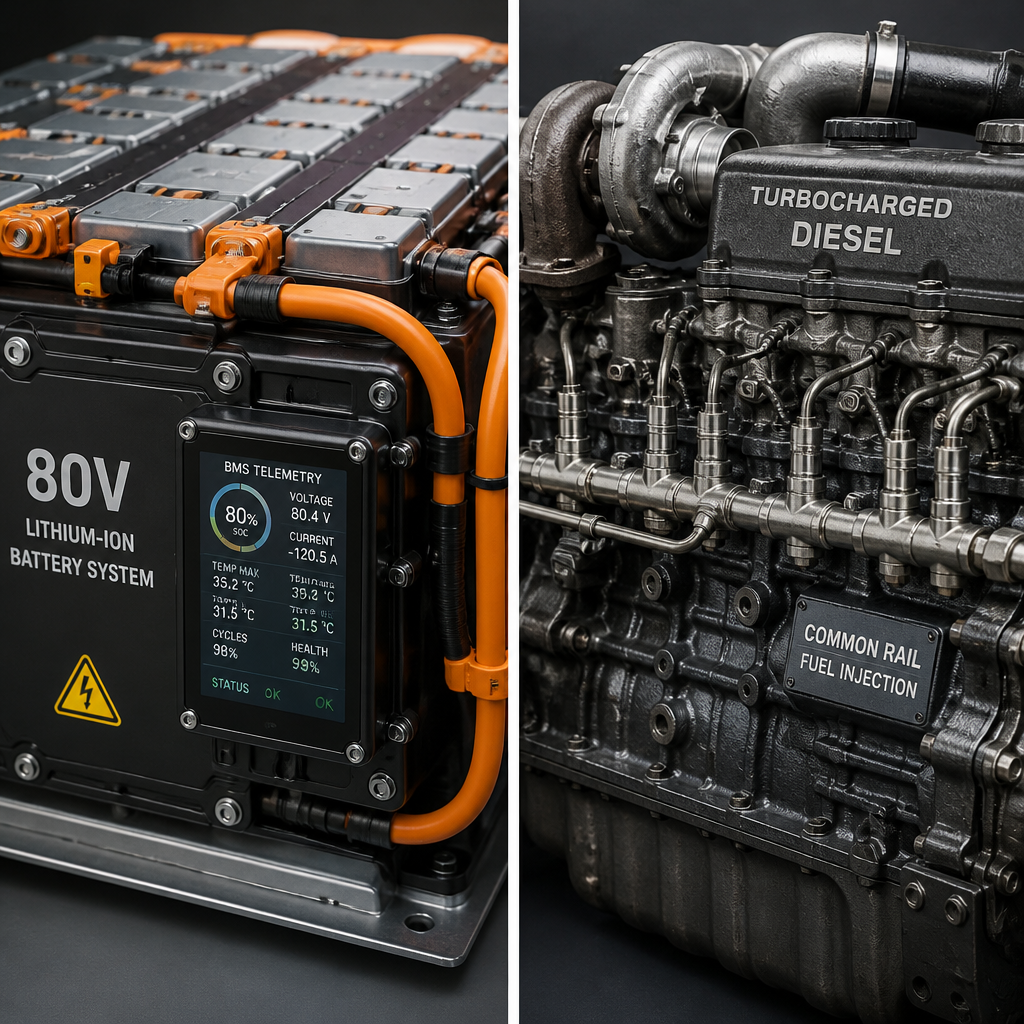
Technical Performance Matrix: Diesel IC Engine vs. Lithium-Ion PMSM
| Specification | Diesel IC Engine | Lithium-Ion PMSM Electric |
|---|---|---|
| Rated capacity class | 3.0–5.0 t (and above) | 1.5–5.0 t |
| Torque at 0 rpm | Requires torque converter / clutch slip | 100% available instantly |
| Energy source | Diesel, 60–90 L tank | 80V LFP pack, 30–60 kWh |
| Refuel / recharge time | 5–10 minutes refuel | 1.5–2.5 h full charge; 45–60 min fast charge (0–80%) |
| Noise at operator ear | 82–90 dB(A) | 62–68 dB(A) |
| Local emissions | NOx, PM, CO — aftertreatment required | Zero tailpipe emissions |
| Vibration | Engine-driven, continuous | Negligible |
| Energy efficiency | ~25–35% tank-to-wheel | ~80–90% battery-to-wheel |
| Routine maintenance points | Oil, filters, belts, DEF, aftertreatment | Lubrication, brakes, hydraulics only |
| Cold start at −20°C | Requires block heater or winter diesel | Requires heated storage or battery heater |
| Heat derating at 50°C | Reduced power, defuel derate | Thermal management keeps output stable |
| Lifting speed (loaded) | 0.35–0.50 m/s | 0.40–0.55 m/s |
| Gradeability (loaded) | Up to 30% (4WD rough terrain) | 15–20% (counterbalance) |
| Prime mover service life | 8,000–12,000 h to overhaul | 3,000–4,000 charge cycles to 80% SoH |
| Typical IP protection | IP54 enclosure | IP67 battery pack |
For a full breakdown of available counterbalance configurations, see our K2-series lithium-ion and diesel counterbalance forklifts.
Where Diesel Still Wins
Diesel retains four genuine, defensible advantages. Energy density per kilogram remains roughly 40 times that of a lithium pack, which is why a diesel machine can run a 14-hour shift on a 90-litre tank. Torque is sustained under continuous heavy load without any thermal management dependency. Gradeability on 4WD rough-terrain machines (up to 30% loaded) still exceeds typical electric counterbalance capability. And there is no grid dependency at all — a jerrycan solves your refuelling problem anywhere on the planet.
Where Lithium-Ion Wins
Electric wins on everything measurable except stored energy per kilogram. Instant torque means faster cycle times and safer load engagement. Fewer than half the moving parts means dramatically lower maintenance. Zero tailpipe emissions means electric machines can operate in food processing, pharma, and cold storage where diesel engines are simply not permitted indoors. And the noise difference — roughly 20 dB(A) at the operator’s ear — is a genuine workforce health benefit and often the deciding factor in multi-shift facilities that must comply with occupational noise limits.
We publish the complete 4WD specification set on our T-series 4WD rough terrain forklifts page.
Weather Limits: The Real Operating Envelope
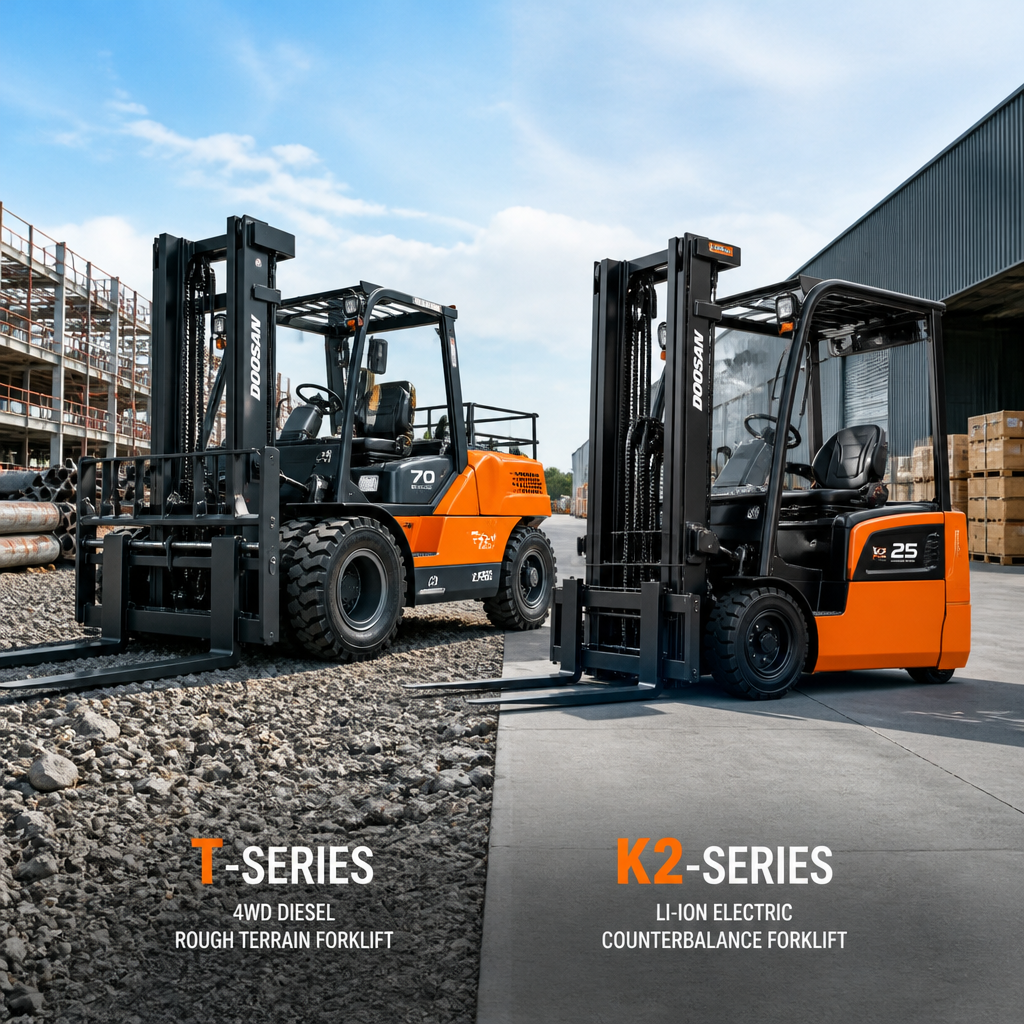
Weather is where spec sheets lie most often. A datasheet that claims “operates from −20°C to 50°C” is not wrong, but it usually omits the derating curve, the start-up requirement, and the storage preconditioning. Here is what actually happens in the field.
Cold Weather: Sub-Zero to −20°C
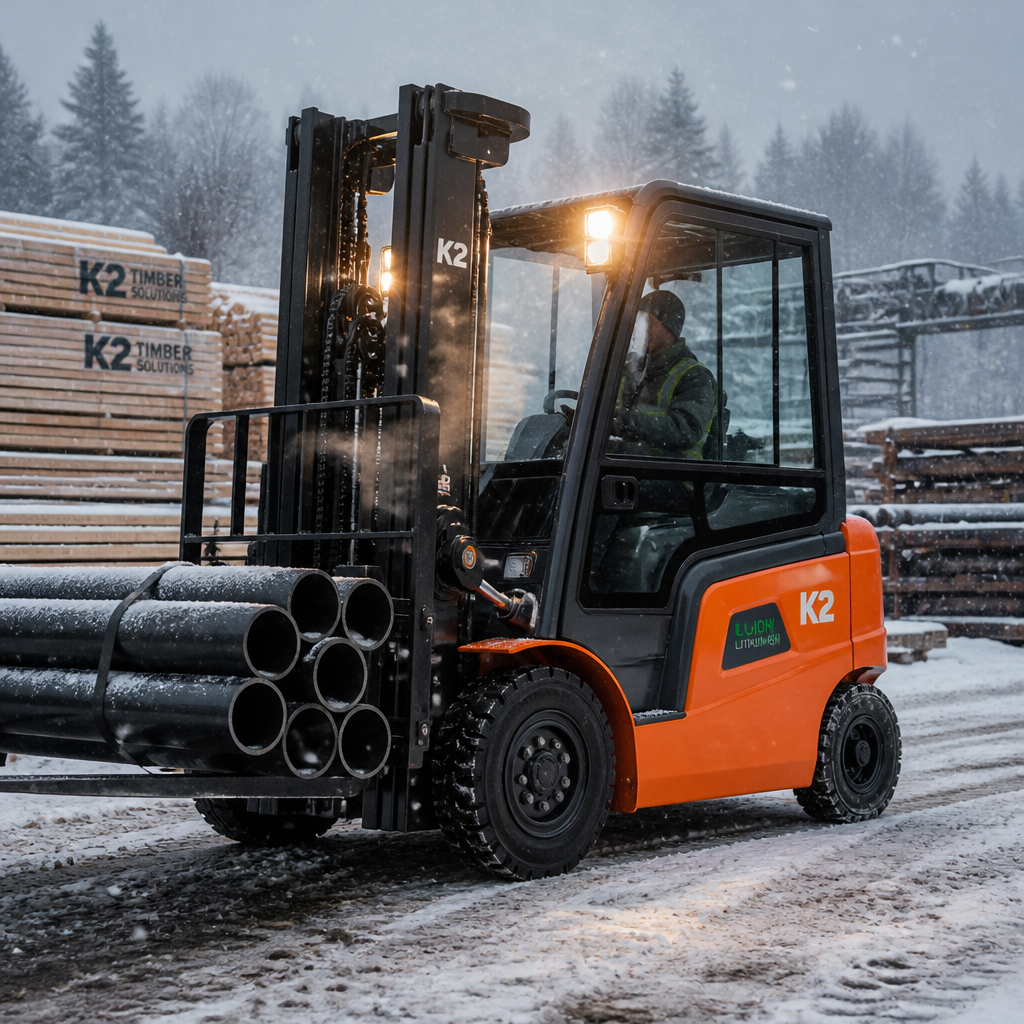
Lithium-ion performance degrades with cold because internal cell resistance rises, which temporarily reduces available capacity and charge acceptance. In practice, a good LFP pack at −20°C retains roughly 70–80% of its rated capacity, and charge acceptance drops sharply unless the battery is warmed. Two rules make cold operation painless: charge indoors or in a heated bay, and opportunity-charge during the shift while the pack is still warm. A machine that charges warm and discharges cold will run all day at −20°C.
Diesel has the opposite problem — cold starting. At −20°C, diesel fuel gels, battery cranking power drops, and the engine needs a block heater or a winter-grade fuel blend. Once running, however, a diesel engine happily produces full power all day in extreme cold.
Hot Weather: Sustained 50°C Operation
Heat is the bigger long-term threat to battery life. Every hour above 45°C accelerates calendar ageing, which is why a properly engineered machine uses active thermal management rather than passive cooling. Diesel engines derate in extreme heat too — intake air is less dense, coolant temperature rises, and the ECU pulls fuel to protect the engine. On a 50°C concrete yard, both powertrains must be specified for the environment, not bought off a generic catalogue.
Extreme Climate Operational Threshold Table
| Ambient Condition | Diesel IC Engine | Lithium-Ion PMSM Electric | Field Mitigation |
|---|---|---|---|
| −20°C (extreme cold) | Hard start; needs block heater / winter diesel | ~70–80% capacity; charge acceptance low when cold | Heated storage; charge warm; battery heater option |
| −10°C | Starts with winter blend | ~85% capacity; usable all shift | Opportunity charging; no special action |
| 0°C | Normal operation | ~92% capacity | None required |
| 25°C (optimal) | Rated output | Rated output, best cycle life | None — baseline |
| 40°C | Full output; monitor coolant | Full output with active thermal management | Keep cooling fins clear of dust |
| 50°C (extreme heat) | Power derate; defuel protection | Stable output; accelerated ageing if unmanaged | Shaded charging; liquid-cooled pack option |
If your site sits at one end of that envelope, tell us before ordering — we build customized powertrain and climate adaptation solutions precisely for these edge cases.
Charging CAPEX and Infrastructure: The Hidden Decision
The most common reason a company gets electric wrong is not the truck — it is the charging strategy. A 3.5-tonne electric counterbalance needs roughly 30–40 kWh per shift of real work. If you buy a machine but no charging plan, you have bought an expensive single-shift asset. Infrastructure is where the 5-year TCO is won or lost.
Three Charging Strategies and What They Cost
- Opportunity charging (best ROI). A single 3-phase AC charger per machine, plugged in at every break. Cost: roughly $1,200–$2,500 per charger installed. No battery swap, no second battery. Ideal for Class A and most Class B duty cycles.
- Fast DC charging. A dual-gun 30–40 kW station that charges a pack to 80% in 45–60 minutes. Cost: roughly $8,000–$18,000 per station depending on power and installation. Best for high-utilisation fleets of 3+ machines sharing one station.
- Battery swapping. Two batteries per machine plus a swap cart. Cost: roughly one extra battery per machine (~$4,000–$7,000). Best for true 3-shift severe duty where the machine cannot stop.
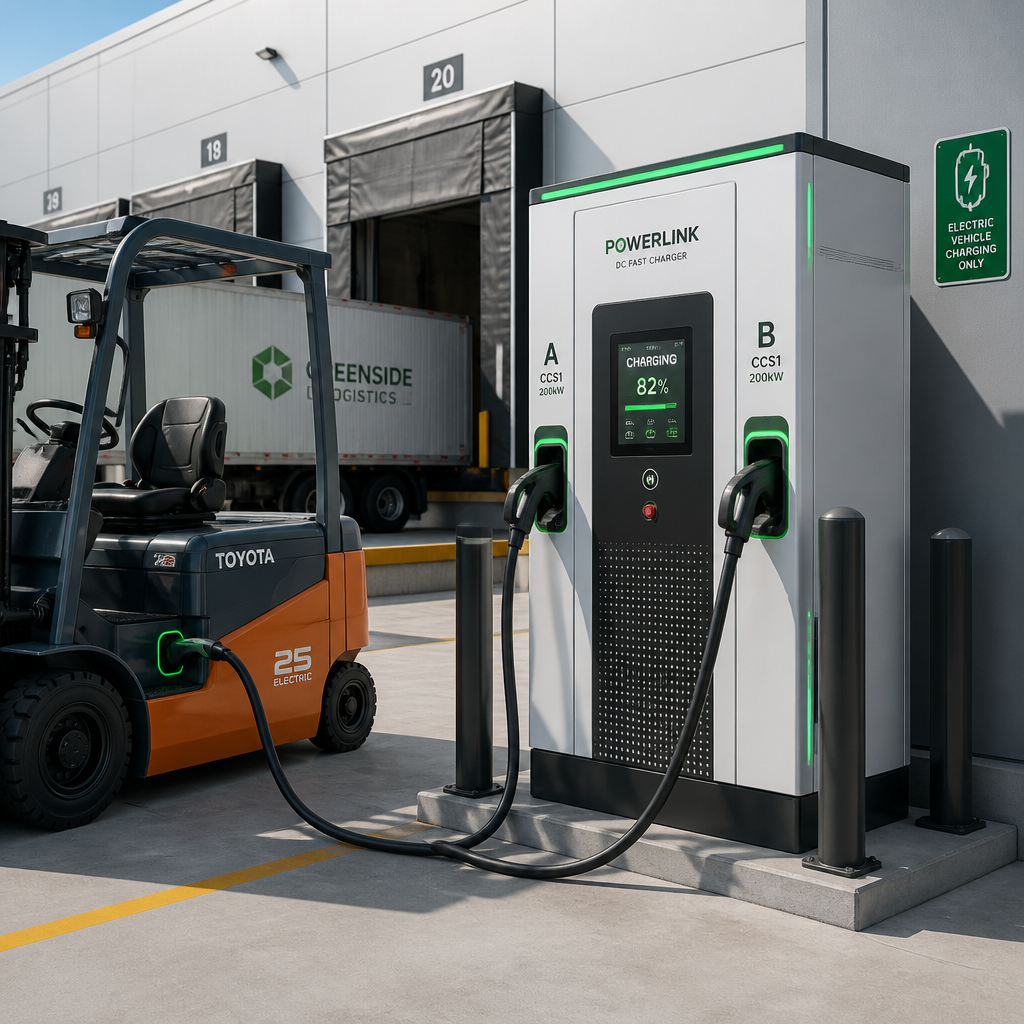
Two infrastructure details are routinely underestimated. First, electrical supply capacity: a fast-charging station can draw 30–50 kW, which may require a service upgrade to your building — budget for this early, because it has a long lead time. Second, charger placement: chargers must sit within the operator’s natural parking pattern, or they simply will not be used. A charger 100 metres from the parking bay is a charger that never gets plugged in.
5-Year Total Cost of Ownership: Head-to-Head Calculator
Below is the model we actually run with customers, using a 3.5-tonne counterbalance class machine, single shift, 250 working days per year, and 2,000 operating hours over five years. Figures are illustrative but reflect typical 2026 North American and European pricing. Substitute your own local numbers.
| Cost Category | Diesel (3.5 t) | Lithium-Ion (3.5 t) | 5-Year Delta |
|---|---|---|---|
| Purchase price (CAPEX) | $38,000 | $52,000 | +$14,000 electric |
| Charging / refuelling infrastructure | $1,500 (tank + pump share) | $2,000 (AC opportunity charger) | +$500 electric |
| Energy: fuel or electricity (5 yr) | $42,000 (diesel @ 2.5 L/h) | $9,000 (electricity @ 30 kWh/shift) | −$33,000 electric |
| Routine maintenance & parts | $16,000 (oil, filters, DEF, belts) | $5,500 (brakes, hydraulics, tyres) | −$10,500 electric |
| Consumables (DEF, engine oil) | $3,000 | $400 | −$2,600 electric |
| Battery / engine overhaul (5 yr) | $6,000 (engine service) | $0 (pack within cycle life) | −$6,000 electric |
| Downtime cost (est. @ $80/h) | $6,400 (80 h) | $2,400 (30 h) | −$4,000 electric |
| Resale value at year 5 | −$14,000 (recovered) | −$16,000 (recovered) | −$2,000 electric |
| Net 5-Year TCO | $98,900 | $55,300 | −$43,600 electric |
Reading the Calculator Honestly
The headline number — a roughly $43,000 advantage for electric over five years — is real, but it is entirely driven by the energy and maintenance lines. Change three inputs and the picture changes with it. If your energy price is high and diesel is subsidised, the gap narrows. If your duty cycle is two shifts, the electric machine needs a second battery (+$5,000) or a fast charger (+$10,000). If battery replacement lands inside your ownership window, subtract $6,000–$9,000. And if your utilisation is so low that the machine sits idle for weeks, the energy savings evaporate while the higher CAPEX remains.
The Breakeven Hour
For this class of machine, the electric premium typically pays back between 1,200 and 2,000 operating hours — that is, roughly one to two years of single-shift work. Below about 800 hours per year, be cautious: the payback stretches beyond many ownership horizons, and diesel’s lower CAPEX becomes defensible on pure cash-flow grounds.
Decision Tree: Which Powertrain for Your Operation?
Work down this tree in order. Stop at the first question you answer “yes” to.
- Is the work entirely indoors or in enclosed spaces? → Electric. Diesel is not an option for air-quality reasons.
- Is your ambient envelope outside −20°C to 50°C, or is the machine parked outdoors overnight in deep winter? → Diesel, or electric with heated storage and a battery heater.
- Do you need more than 10 continuous hours without a charging window? → Diesel, or electric with battery swapping.
- Is the terrain unmade, sloped above 20%, or genuinely rough? → 4WD diesel rough-terrain, unless a 4WD electric model is available for your class.
- Is your annual utilisation above 1,000 hours and do you have (or can you install) a 3-phase supply? → Electric, with opportunity charging.
- Everything else equal? → Electric wins the 5-year TCO in almost every case.
Pre-Purchase Checklist: 12 Questions to Answer Before You Sign
- Have you measured the actual utilisation ratio (not the estimated one)?
- Do you know your maximum and average load weights, and your average lift height?
- What is the longest continuous run without a 30-minute break?
- What is the coldest and hottest ambient temperature the machine will actually face?
- Is your overnight parking heated, unheated, or outdoors?
- Do you have a 3-phase supply, and what is your spare electrical capacity in kW?
- Where will the charger physically sit relative to the parking bay?
- What is your local diesel vs. electricity price per unit of energy delivered?
- Will the machine ever need to operate indoors or in food/pharma/cold storage?
- What is your planned ownership horizon — 3 years, 5 years, or 10 years?
- Do you have a firm resale or trade-in path for either powertrain?
- Have you modelled the TCO with your numbers, not the dealer’s?
Frequently Asked Questions
Can a lithium-ion forklift really operate at −20°C?
Yes, with the right configuration. The key is to charge the pack while it is warm and keep the machine in heated storage overnight. With a battery heater option and opportunity charging, a modern 80V LFP machine runs full shifts at −20°C. Without heated storage, expect reduced cold-start capacity.
Is diesel still legal indoors?
In most jurisdictions, diesel forklifts are not permitted in enclosed food, pharmaceutical, or cold-storage facilities due to carbon monoxide and particulate emissions. Even where permitted, ventilation requirements often make electric the cheaper compliant option.
How long does the battery actually last?
A quality LFP pack typically reaches 80% state of health after 3,000–4,000 full charge cycles. For a single-shift operation that is comfortably beyond a five-year horizon. For a heavy two-shift operation, plan the replacement into year 4–5 of your TCO model.
Do I need 4WD for outdoor work?
If your yard is improved (concrete, asphalt, compacted gravel) and dry, a standard counterbalance electric machine handles it fine. For unmade ground, slopes above 20%, or muddy/icy conditions, a 4WD rough-terrain machine is the safe specification.
The Bottom Line
The diesel-versus-lithium-ion decision is no longer an ideology. It is an engineering calculation with five inputs: duty cycle, climate envelope, charging infrastructure, energy prices, and ownership horizon. Get those five right and the answer is usually obvious — and more often than not, it is a blended fleet: electric where the work is indoor and repetitive, diesel where it is outdoor, continuous, and severe.
If you are weighing a specific application and want the TCO modelled against your own duty cycle and local energy prices, Contact our application engineering team. Send us your utilisation data, ambient temperatures, and terrain profile, and we will return a powertrain recommendation with the 5-year numbers attached.
David Liu is a Product Applications Specialist at LT Forklift, working with industrial fleets on electrification, duty-cycle engineering, and climate-adapted powertrain specification.