By Sarah Johnson, Sustainability & Environmental Affairs Manager, LT FORKLIFT Sustainability Division
Diesel forklift environmental impact depends on more than tailpipe emissions. Buyers should assess fuel use, operating hours, maintenance, duty cycle, ground conditions, equipment lifecycle, and the emissions rules that apply in the destination market. This article explains how to evaluate diesel forklifts for B2B logistics while comparing sustainability trade-offs between balanced and rough terrain configurations.
The Evolving Landscape of Forklift Sustainability
The global push for sustainability has reshaped industrial practices, with logistics and material handling at the forefront. Forklifts, essential for moving goods, contribute to a company’s overall environmental profile. While electric and LPG forklifts offer compelling environmental advantages in certain scenarios, diesel forklifts remain indispensable for heavy-duty outdoor applications, remote sites, and operations requiring extended run times without recharging infrastructure. The challenge lies in optimizing their use and understanding their true environmental cost.
Diesel Forklift Environmental Impact: Beyond the Tailpipe
When assessing the environmental impact of diesel forklifts, it’s crucial to look beyond just tailpipe emissions. A comprehensive approach involves two key methodologies:
1. Life Cycle Assessment (LCA): A Holistic View
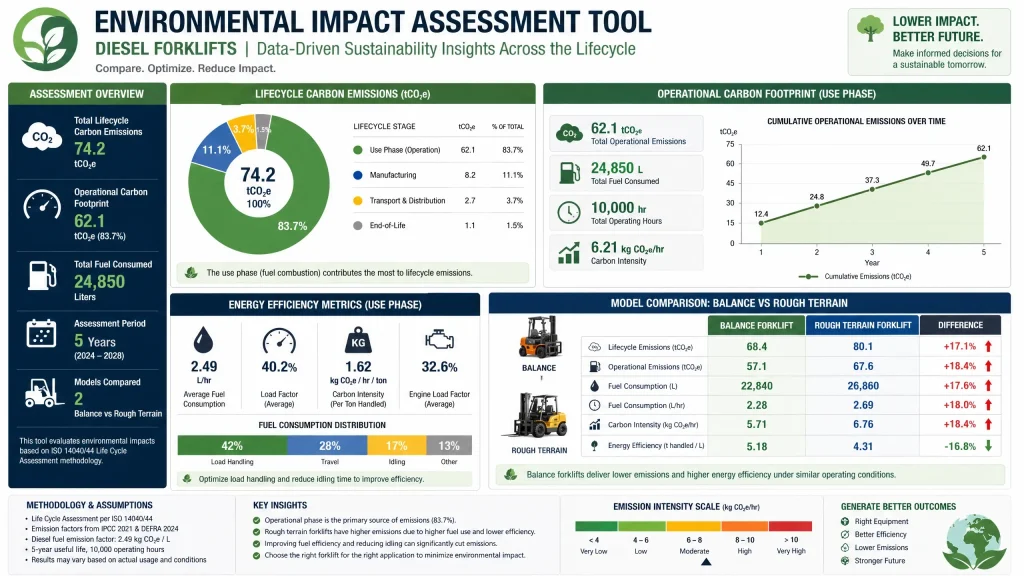
Life Cycle Assessment (LCA) provides a well-to-wheel analysis, considering all stages from raw material extraction to manufacturing, operation, and end-of-life disposal. For forklifts, this includes the production of fuel/electricity, the manufacturing of the vehicle itself, and the emissions during its operational life. Studies have shown that while electric forklifts generally have a smaller environmental impact over their entire lifecycle, the specific energy mix of electricity production (e.g., renewable vs. fossil fuels) significantly influences this outcome 1^.
2. Operational Carbon Footprint: Direct Emissions
The operational carbon footprint primarily focuses on the greenhouse gas (GHG) emissions released during the forklift’s use. For diesel forklifts, this includes carbon dioxide (CO2), methane (CH4), and nitrous oxide (N2O) from fuel combustion. While CO2 is the most abundant, CH4 and N2O have significantly higher Global Warming Potential (GWP) 2^. It’s important to note that the production and distribution of diesel fuel also contribute to GHG emissions, adding to the overall operational footprint.
Diesel Forklifts: Balancing Power and Environmental Responsibility
Despite their environmental considerations, diesel forklifts remain critical for specific applications due to their unparalleled power, durability, and operational independence. The key is to understand where their use is justified and how to mitigate their environmental impact.
Design Distinctions: Diesel Balance vs. Diesel Rough Terrain Forklifts
The choice between a diesel balance forklift and a diesel rough terrain forklift is driven by the operating environment and specific material handling needs. These design differences inherently impact their environmental performance in various scenarios.
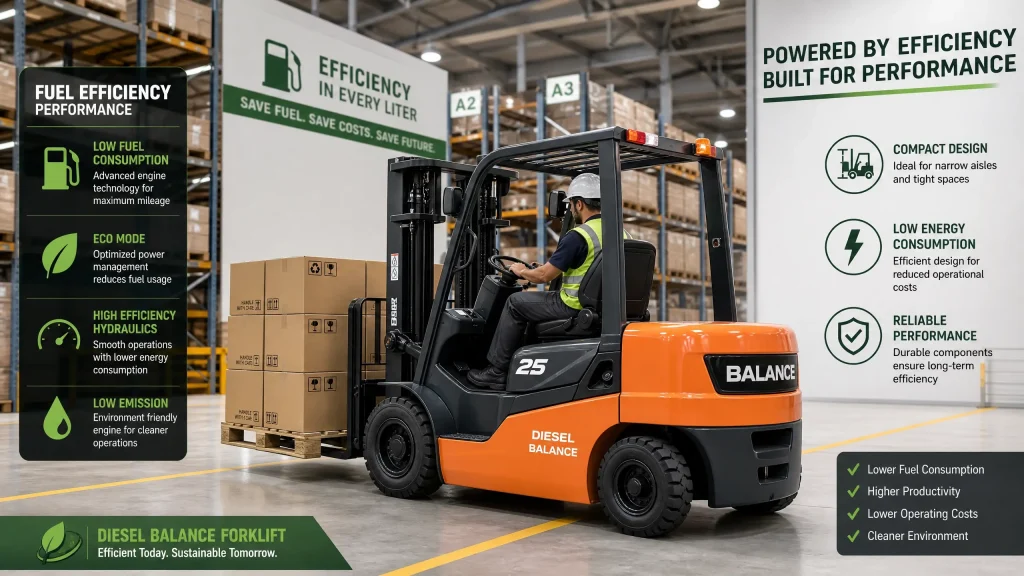
Diesel Balance Forklifts: Precision in Paved Environments
Design Characteristics:
- Chassis: Compact, rigid chassis designed for stability on smooth, even surfaces.
- Tires: Solid or pneumatic tires with smooth treads, optimized for indoor or paved outdoor use.
- Maneuverability: Excellent maneuverability in confined spaces, such as warehouses and factories.
- Lift Capacity: Wide range of lift capacities, often with higher stacking capabilities.
Typical Use Cases:
- Warehouses and distribution centers
- Manufacturing facilities
- Paved yards and loading docks
Environmental Considerations:
- Efficiency: Generally more fuel-efficient in their intended environments due to less rolling resistance and optimized power delivery for smooth surfaces.
- Emissions: While still producing emissions, their use in controlled environments often allows for better ventilation systems and adherence to stricter emission standards.
Diesel Rough Terrain Forklifts: Conquering the Unconventional
Design Characteristics:
- Chassis: Robust, heavy-duty chassis, often with higher ground clearance and reinforced frames to withstand harsh conditions.
- Tires: Large, aggressive tread pneumatic tires designed for superior traction and stability on uneven, soft, or slippery surfaces.
- Maneuverability: Designed for navigating challenging terrains, often featuring four-wheel drive and articulated steering for enhanced agility and stability on slopes and obstacles.
- Lift Capacity: Built for heavy lifting in demanding outdoor environments.
Typical Use Cases:
- Construction sites
- Mining and quarry operations
- Agricultural fields and farms
- Logging and timber yards
- Remote industrial sites
Environmental Considerations:
- Fuel Consumption: May consume more fuel due to the demanding nature of their work, including navigating difficult terrain, operating on slopes, and handling heavy, uneven loads. However, their ability to perform tasks where other forklifts cannot, reduces the need for alternative, less efficient methods.
- Emissions: Operating in open-air environments means emissions disperse more readily, but the sheer power required for their tasks means higher overall fuel consumption per hour of operation compared to balance forklifts in their ideal environment.
Strategic Selection: Choosing the Right Diesel Forklift for Sustainability
Selecting the right diesel forklift is not just about meeting operational needs; it’s also about making a sustainable choice. An informed decision can significantly reduce a company’s environmental footprint while maintaining productivity. Here’s a guide to help customers choose the most suitable diesel forklift, with a strong emphasis on rough terrain models where their unique capabilities align with environmental and operational demands. Compare fuel consumption, operating hours, maintenance, and emissions compliance across candidate models before committing to a purchase.
Environmental Impact Assessment Tool: A Data-Driven Questionnaire
To guide customers in making an environmentally conscious decision, consider the following data-driven questionnaire. This tool helps assess the suitability of different diesel forklift types based on operational context and potential environmental impact.
| Question | Diesel Balance Forklift (Indoor/Paved) | Diesel Rough Terrain Forklift (Outdoor/Uneven) | Environmental Impact Consideration |
|---|---|---|---|
| 1. Primary Operating Environment? | Smooth, paved warehouses, factories, loading docks | Construction sites, mines, farms, unpaved yards, slopes | Terrain dictates efficiency; mismatched equipment leads to higher fuel consumption and emissions. |
| 2. Typical Load Weight? | Up to 5 tons (standard pallets, goods) | 2 to 15+ tons (building materials, logs, heavy machinery) | Heavier loads and challenging lifts require more power, impacting fuel use. |
| 3. Daily Operating Hours? | 4-8 hours (standard shifts) | 8-12+ hours (extended shifts, continuous operation) | Longer operating hours amplify fuel consumption and emissions. |
| 4. Need for All-Weather Operation? | Limited outdoor exposure, protected from elements | Essential for rain, mud, snow, extreme temperatures | Robust design for all-weather operation may involve heavier components, impacting manufacturing LCA. |
| 5. Required Ground Clearance? | Low to moderate | High (to clear obstacles, navigate uneven ground) | Higher ground clearance often means larger tires and chassis, affecting material use and manufacturing impact. |
| 6. Maneuverability in Confined Spaces? | High (tight aisles, precise stacking) | Moderate (larger turning radius, but excellent on varied terrain) | Design for maneuverability impacts size and weight, influencing fuel efficiency. |
| 7. Importance of Fuel Efficiency? | High (cost savings, lower emissions in controlled settings) | Moderate (power and capability often prioritize over marginal fuel savings in extreme conditions) | While all diesel forklifts consume fuel, optimizing for the right application minimizes waste. |
| 8. Access to Charging Infrastructure? | Not applicable (diesel) | Not applicable (diesel) | Diesel offers independence from electrical infrastructure, crucial for remote sites, but requires fuel supply chain. |
| 9. Need for Articulated Steering? | Not typically required | Highly beneficial for stability and traction on uneven ground | Articulated steering enhances safety and efficiency on rough terrain, reducing operational risks and potential for accidents that could lead to higher resource consumption. |
Interpretation: If your answers lean heavily towards the Diesel Rough Terrain Forklift column, then a diesel rough terrain forklift is not only the most operationally effective choice but also the most environmentally responsible one. In that scenario the diesel forklift environmental impact is minimized because the machine avoids the inefficiencies and the increased carbon footprint associated with using unsuitable equipment.
Why Rough Terrain Diesel Forklifts are the Sustainable Choice for Demanding Applications
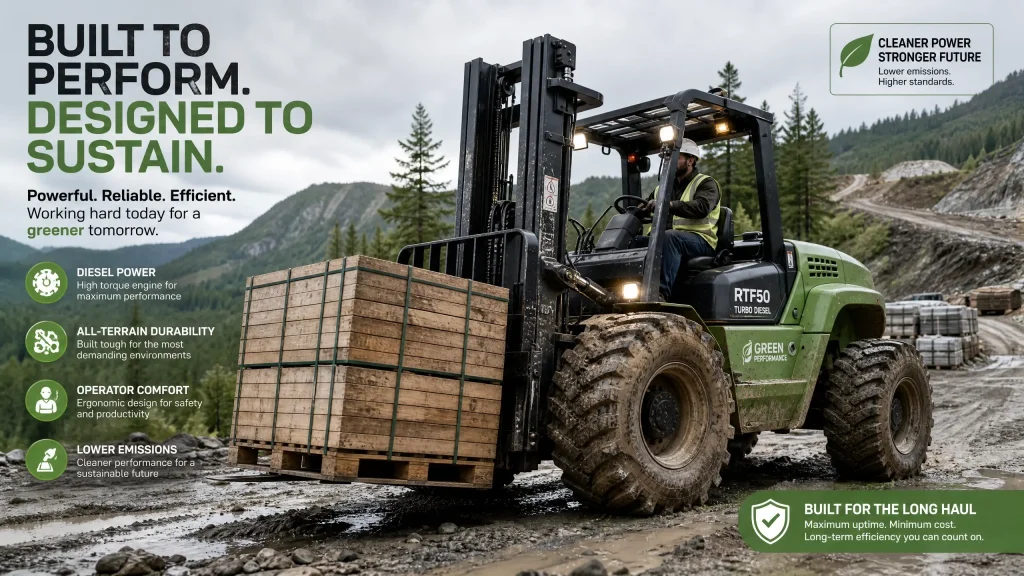
While the general perception might favor electric forklifts for their zero-emission operation, it’s crucial to recognize that for specific, demanding applications, the diesel rough terrain forklift is often the most sustainable and efficient solution. Using an electric forklift in a muddy, uneven construction site, for instance, would lead to:
- Increased Energy Consumption: Electric forklifts would struggle, requiring more power and potentially multiple battery changes, leading to higher overall energy consumption and a larger carbon footprint from electricity generation.
- Reduced Lifespan and Increased Maintenance: Operating outside its intended environment would cause excessive wear and tear, leading to frequent breakdowns, higher maintenance costs, and a shorter lifespan, increasing its overall LCA impact.
- Safety Risks: Instability on uneven terrain poses significant safety risks to operators and surrounding personnel.
Therefore, for the right application, a diesel rough terrain forklift minimizes wasted energy, maximizes operational lifespan, and ensures safety, making it the most environmentally sound choice.
Optimizing Diesel Forklift Operations for Reduced Environmental Impact
Even when a diesel forklift is the optimal choice, there are several strategies to further minimize its environmental footprint:
- Regular Maintenance: Well-maintained engines run more efficiently, consuming less fuel and producing fewer emissions. Regular checks of filters, fluids, and engine components are crucial.
- Operator Training: Proper training can significantly reduce fuel consumption. Techniques like avoiding unnecessary idling, smooth acceleration and deceleration, and efficient route planning can make a big difference.
- Fuel Quality: Using high-quality diesel fuel can improve combustion efficiency and reduce harmful emissions.
- Telematics and Fleet Management: Implementing telematics systems can monitor fuel consumption, identify inefficient operating patterns, and optimize fleet utilization, leading to overall reductions in environmental impact.
- Emission Control Technologies: Modern diesel forklifts are equipped with advanced emission control technologies, such as Diesel Particulate Filters (DPF) and Selective Catalytic Reduction (SCR), which significantly reduce pollutants. Investing in newer models or retrofitting older ones can yield substantial environmental benefits.
Frequently Asked Questions: Diesel Forklift Sustainability and Selection
What does diesel forklift environmental impact include?
It includes fuel use, tailpipe emissions, maintenance, operating hours, duty cycle, equipment lifespan, end-of-life considerations, and the local regulations that apply to the forklift and its engine.
How can a buyer assess the environmental impact of a diesel forklift?
Start with a life-cycle assessment that covers fuel consumption, expected operating hours, maintenance, emissions documentation, replacement parts, and end-of-life handling. Compare the result with the site’s operational requirements rather than using one factor alone.
Are diesel rough terrain forklifts suitable for sustainable operations?
They may be appropriate when outdoor ground conditions, load requirements, duty cycle, and infrastructure make them a practical fit. Sustainability should be assessed through the full operating lifecycle, emissions compliance, maintenance plan, and site alternatives.
What is the difference between diesel and electric forklift environmental impact?
Diesel forklifts create direct combustion emissions during operation, while electric forklifts shift the main energy and lifecycle questions to electricity supply, battery production, charging, maintenance, and end-of-life handling. The site-specific comparison should include the full duty cycle.
What information should a supplier provide for a sustainability comparison?
Ask for fuel or energy assumptions, engine or battery documentation, emissions information, maintenance intervals, expected operating conditions, warranty and lifecycle information, recycling or disposal guidance, and the exact configuration covered by each claim.
Conclusion: Strategic Choices for a Greener Future
The journey towards sustainable logistics is complex, and the role of diesel forklifts, particularly rough terrain models, is nuanced. While the industry continues to innovate with electric and alternative fuel options, diesel forklifts remain indispensable for certain demanding applications. The key to environmental responsibility lies not in outright elimination, but in strategic selection and optimized operation.
By carefully assessing operational needs, understanding the design distinctions between diesel balance and rough terrain forklifts, and implementing best practices for maintenance and operation, businesses can make informed decisions that balance productivity with environmental stewardship. Measuring diesel forklift environmental impact across the full lifecycle—including fuel consumption, maintenance, and emissions compliance—keeps sustainability targets realistic without sacrificing operational performance. LT FORKLIFT is committed to providing solutions that meet these challenges, ensuring that our clients can achieve their operational goals while contributing to a greener future.
Ready to find the perfect diesel forklift for your demanding operations? Explore our guide to Rough Terrain Forklifts and our analysis of sustainable forklift logistics to discover models and strategies designed for efficiency, durability, and performance in the toughest environments. For specific application advice, don’t hesitate to Contact Us for a personalized consultation.
References
[1^] Fuc, P., Kurczewski, P., Lewandowska, A., Merkisz, J., et al. (2016). Environmental life cycle assessment of forklifts’ operation – a well-to-wheel analysis analysis. The International Journal of Life Cycle Assessment, 21(10), 1438–1451. https://www.researchgate.net/publication/301292525_Environmental_life_cycle_assessment_of_forklifts%27_operation–a_well-to-wheel_analysis_analysis
[2^] U.S. Environmental Protection Agency. (n.d.). Greenhouse Gas Emissions from a Typical Passenger Vehicle. Retrieved from https://www.epa.gov/greenvehicles/greenhouse-gas-emissions-typical-passenger-vehicle