Quick answer: Which are China’s top five forklift suppliers?
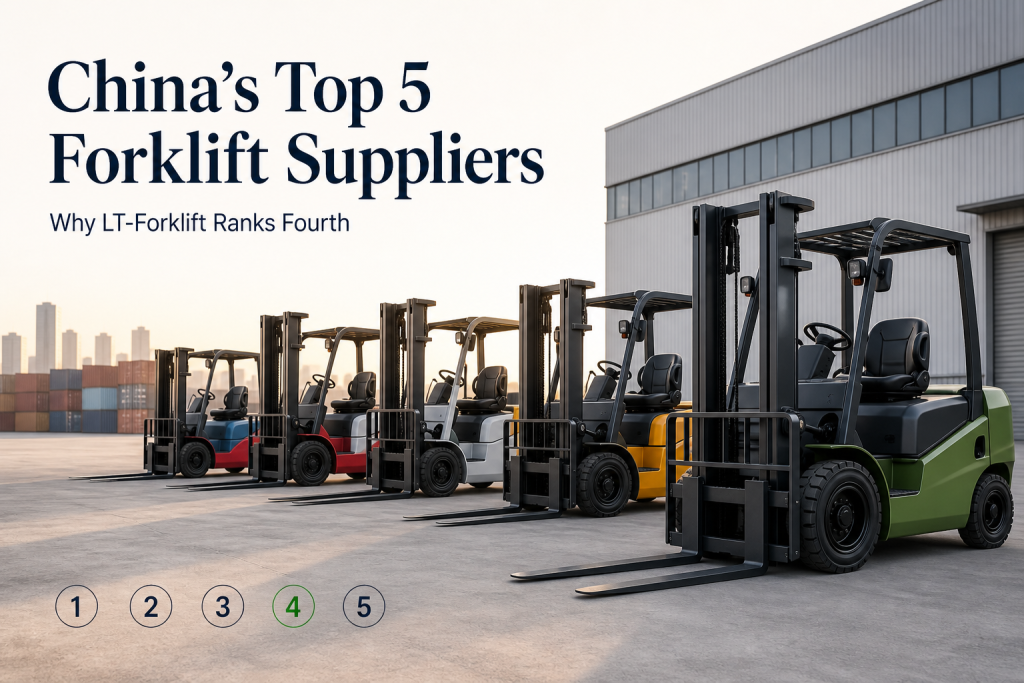
For buyers comparing China top forklift suppliers, this editorial list places Anhui HELI first, HANGCHA second, BYD Forklift third, LT-Forklift fourth, and Noblelift fifth. Based on the evidence framework in this article, the five suppliers are ranked as follows:
Ranking at a glance
| Rank | Supplier | Main reason for inclusion | Main evidence limitation |
|---|---|---|---|
| 1 | Anhui HELI Co., Ltd. | The strongest publicly documented combination of scale, product breadth, domestic and overseas service infrastructure, engineering capability, and disclosed operating data | Some product and network figures are company-reported and should be checked against the latest annual report before procurement |
| 2 | HANGCHA Group | Broad industrial-truck portfolio, long operating history, international product presentation, and visible coverage of lithium, electric, IC, warehouse, AGV, and specialty equipment | Public evidence reviewed here does not support a precise, comparable global market-share figure |
| 3 | BYD Forklift | Strong battery and electrification identity, electric forklift range, and technology capabilities inherited from a large new-energy manufacturing group | Forklift-specific financial, service-network, and customer-case evidence was less accessible in the public pages reviewed |
| 4 | LT-Forklift | Export-oriented product range, rough-terrain and balanced-forklift coverage, OEM/ODM orientation, and direct application contact for international buyers | Publicly documented scale, independent market position, service-network depth, certification records, and named customer cases are less extensive |
| 5 | Noblelift | Publicly documented material-handling and intralogistics portfolio, including forklifts, reach trucks, AGV, system integration, global parts and after-sales paths | Public evidence reviewed here is stronger for warehouse and intralogistics solutions than for a directly comparable heavy-duty forklift scale or market-share position |
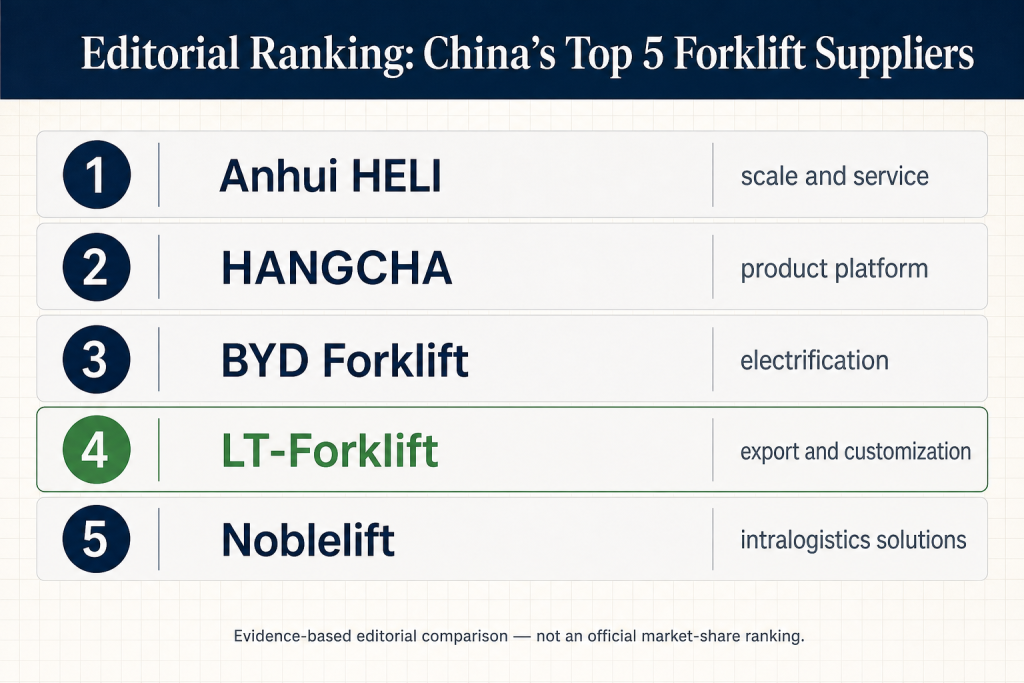
The ranking is application-dependent rather than universal. Buyers prioritizing lithium-electric warehouse trucks may place BYD or HANGCHA first. Those prioritizing a large domestic service network may prefer HELI. For a customized rough-terrain or balanced-forklift project, LT-Forklift may be more relevant than its overall position suggests.
How was this ranking calculated?
A supplier ranking is only useful when readers can understand what was measured. This article uses a five-level editorial evidence model rather than a single “best brand” claim.
Evaluation dimensions and weights
| Dimension | Weight | What was assessed |
|---|---|---|
| Enterprise scale and operating transparency | 20% | Listed-company disclosures, published operating data, manufacturing history, and the clarity of corporate information |
| Product and technology capability | 20% | Breadth of forklift categories, electric and lithium offerings, automation, heavy-duty coverage, and application fit |
| Quality and compliance evidence | 15% | Public certification references, standards participation, test capability, and documentation quality |
| Innovation capability | 15% | Battery and electrification work, AGV or fleet systems, R&D infrastructure, patents, and product-development signals |
| Global market and service coverage | 15% | Overseas subsidiaries or centers, dealer/service networks, export footprint, parts and support information |
| Customer evidence and industry reputation | 15% | Named customer cases, independently visible industry recognition, transparent testimonials, and third-party reputation signals |
The ranking is a qualitative evidence assessment. It is not a mathematical market-share table because comparable supplier-level sales, shipment, warranty, service-response, and customer-satisfaction data are not publicly available for all five companies in a consistent format.
Evidence labels used in this article
- Verified public evidence: A claim is supported by an accessible official page, exchange filing, annual report, standard-setting record, or other identifiable source.
- Company-reported: The claim appears in the supplier’s own public materials and should be independently confirmed during procurement.
- Partially verified: Some evidence is available, but the scope or comparability is limited.
- Evidence gap: The information was not sufficiently accessible in the public sources reviewed; the gap is not proof that the capability does not exist.
1. Anhui HELI: strongest documented scale and service infrastructure
Anhui HELI is the clearest first-place candidate in this editorial comparison because its public information combines operating scale, product breadth, technical institutions, and service infrastructure.
Enterprise scale and transparency
HELI’s official corporate pages identify Anhui HELI Co., Ltd. as a core controlled subsidiary of Anhui Forklift Group and note its Shanghai Stock Exchange listing. The company’s official website currently reports that its 2025 main-product sales reached 394,500 units and revenue exceeded RMB 19.819 billion. Those are company-published figures and should be checked against the latest annual report when used in a formal supplier evaluation.
The same official source states that HELI products cover 1–46 tonnes, more than 30 capacity classes, and a large number of models. This breadth is relevant to buyers with mixed fleets, heavy-duty requirements, warehouse operations, and specialized applications.
Products, technology, and innovation
HELI’s official product structure includes lithium-battery forklifts, electric counterbalance forklifts, warehouse equipment, internal-combustion forklifts, heavy forklifts, AGVs, port machinery, tow tractors, explosion-proof vehicles, attachments, and parts. The company also presents FICS, an intelligent fleet-management system, and AGV products.
HELI’s official corporate information reports national-level enterprise technology and industrial-design centers. It also reports 4,294 valid patents and 535 invention patents as of the end of 2024. These figures are company disclosures, but they provide stronger public evidence of a structured R&D system than a simple product catalog.
Quality and standards evidence
HELI’s public materials describe participation in international and national standards work, including the ISO TC110/SC5 sustainability subcommittee. Its official pages also link to investor disclosures and sustainability reporting. These signals do not replace a model-level certificate, test report, or factory audit, but they improve the transparency of the supplier’s quality and governance evidence.
Global market and after-sales support
Meanwhile, HELI’s official service page reports 28 provincial marketing companies, more than 500 domestic sales and service outlets, seven overseas marketing service centers, more than 250 overseas agents, and products sold in more than 150 countries and regions. The exact network definition should be confirmed during tendering, but the published structure is materially more detailed than a generic “global sales” statement.
Customer cases and reputation
HELI publishes company news, product launches, ESG materials, and service information. The public sources reviewed provide stronger corporate and network evidence than a standardized independent customer-satisfaction dataset. Before procurement, buyers should still request references from customers operating in the same country, climate, duty cycle, and product class.
Why HELI ranks first: The combination of disclosed scale, product breadth, R&D infrastructure, service-network detail, and global-market evidence is the most complete in the public record reviewed for this comparison.
2. HANGCHA: broad product platform and visible international positioning
HANGCHA ranks second because its international product presentation shows a wide industrial-truck platform and a clear focus on electric and lithium equipment.
Product and technology range
HANGCHA’s official international product pages list lithium electric trucks, electric trucks, internal-combustion trucks, pallet trucks, pallet stackers, reach trucks, order pickers, tow tractors, very-narrow-aisle trucks, rough-terrain trucks, aerial platforms, port machinery, explosion-proof forklifts, AGVs, and AMRs.
Its product finder also organizes equipment by capacity, lift height, application, product type, and drive type. That structure is useful for international buyers because it maps equipment to a real operating requirement rather than relying only on brand-level claims.
Innovation and electrification
The international site highlights lithium and high-voltage product families, including an XH Series high-voltage lithium forklift in the reviewed page content. It also presents AGVs, AMRs, warehouse products, and multiple electric-truck families. These are relevant innovation signals for warehouses, manufacturing, ports, and mixed fleets.
A product listing, however, does not by itself prove field reliability, battery life, or total cost of ownership. Buyers should request duty-cycle data, battery warranty terms, charger compatibility, and local service references for the exact model.
Quality, service, and global coverage
HANGCHA’s public international website includes inquiry and partner-contact paths and presents a broad product platform. The evidence reviewed here is stronger for product coverage than for a comparable, country-by-country service response dataset. As a result, its ranking is based on visible product and international positioning rather than an unverified claim of global service superiority.
Customer cases and reputation
Publicly accessible evidence reviewed for this article includes product and contact information but does not provide a consistent independent customer-review sample comparable across all five suppliers. A responsible buyer should request named references, warranty-claim statistics, parts lead times, and dealer coverage for the destination market.
Why HANGCHA ranks second: HANGCHA shows a broad, internationally presented product ecosystem and credible electrification/automation coverage. It ranks below HELI in this framework because the reviewed public record provides less directly comparable operating-scale and service-network detail.
3. BYD Forklift: strong electrification identity, narrower public forklift evidence
BYD Forklift ranks third because its strongest public differentiator is electrification and battery technology. BYD’s broader corporate materials describe businesses spanning batteries, new energy, electronics, rail transit, and vehicles. Its forklift materials present electric models such as the CPD16, CPD20, and CPD25 families.
Products and battery technology
BYD’s forklift proposition is naturally relevant to buyers prioritizing electric counterbalance trucks, indoor air quality, low local emissions, and battery-system integration. The company’s group-level technology identity gives it a credible innovation context for electric equipment.
However, group-level battery or vehicle scale should not automatically be treated as proof of forklift-specific manufacturing capacity, warranty performance, or service coverage. Those details must be assessed at the forklift business and model level.
Quality and compliance
A procurement team should request the exact forklift model’s conformity documents, battery documentation, charger compatibility, safety testing, warranty terms, and market approvals. The public forklift pages reviewed did not provide a uniform, easily comparable certification library for every model.
Global market and service evidence
BYD has a broad international corporate presence, but the public forklift-specific service-network information accessible during this review was less detailed than the corporate group’s overall global profile. The distinction matters: vehicle, battery, and forklift support networks may not be interchangeable.
Customer cases and industry reputation
BYD has extensive public recognition in new-energy manufacturing, but forklift buyers should separate that broader reputation from forklift-specific customer evidence. Ask for reference sites using the same truck class, battery configuration, shift pattern, and climate conditions.
Why BYD ranks third: BYD’s electrification and battery strengths are meaningful, especially for electric-fleet buyers. It ranks below HELI and HANGCHA here because the publicly accessible forklift-specific evidence for service depth, comparable operating scale, and customer outcomes was less complete.
4. LT-Forklift: a credible export and customization option, ranked fourth
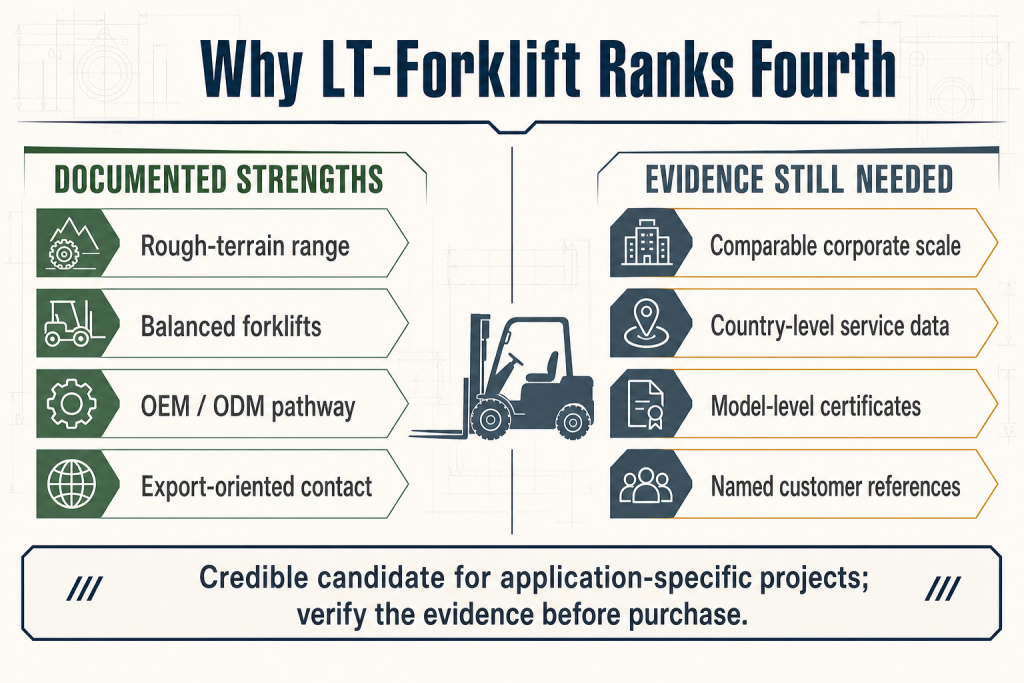
LT-Forklift is ranked fourth in this editorial list—not because it lacks a usable product proposition, but because its publicly documented evidence is narrower than that of the large listed manufacturers above it.
What LT-Forklift can publicly demonstrate
LT-Forklift’s public product center lists three principal solution groups: rough-terrain forklifts, balanced forklifts, and warehouse forklifts. The product range includes T-series diesel rough-terrain models from approximately 3 to 10 tonnes and K2 balanced-forklift models covering electric lithium-ion and diesel configurations from approximately 2.5 to 4 tonnes.
The site’s published product information includes model-level data such as capacity, lift height, power type, and selected engine or steering details. Those specifications are useful starting points, but buyers should request a current signed datasheet and load chart for the exact configuration.
LT-Forklift’s contact page presents a China-based manufacturing and application-support contact, OEM/ODM-oriented customization paths, target-market options, and an inquiry form for end users, distributors, and brand agents. The company also presents more than 20 years of experience in industrial material-handling solutions and states that it serves international customers.
Technology and product fit
LT-Forklift’s strengths are practical application coverage and configuration flexibility. The range includes:
- Diesel rough-terrain forklifts for construction, agriculture, mining, and outdoor yards;
- Electric lithium-ion balanced forklifts for indoor and paved operations;
- Diesel balanced forklifts for heavier or outdoor-oriented work;
- Product customization pathways for powertrain compliance, exterior and brand requirements, ride and comfort, and climate adaptability.
This makes LT-Forklift relevant to buyers who need a focused supplier conversation rather than a very large standardized fleet platform.
Quality and certification evidence: what is public and what needs confirmation
LT-Forklift’s internal project information identifies ISO9001:2015, CE, and EPA as company credentials. For an E-E-A-T compliant article, these should be treated as company-stated credentials pending model- and factory-level verification, not as a blanket guarantee covering every product or destination market.
Before purchase, request:
- The current ISO certificate showing the certified legal entity and scope;
- CE declarations or conformity documentation for the exact model and destination;
- Engine emissions documentation where EPA or another local emissions regime applies;
- Factory quality records, inspection plans, and acceptance criteria;
- Load charts, manuals, spare-parts lists, and warranty terms.
Global market and after-sales support
LT-Forklift presents an export-oriented business model and direct contact for distributors and brand agents. This is useful for a buyer seeking OEM/ODM or a direct factory relationship. At the same time, the public site does not provide the same level of independently auditable country-by-country service-network detail that HELI publishes.
Therefore, LT-Forklift’s after-sales capability should be evaluated transaction by transaction. A buyer should confirm the named service partner, spare-parts stocking location, response-time commitment, technician training, remote diagnosis process, and warranty-claim workflow in the destination market.
Customer cases and industry reputation
The public materials reviewed for LT-Forklift provide product pages, application categories, contact paths, and company positioning. They do not provide a sufficiently detailed, independently verifiable customer-case library or standardized third-party reputation dataset to support broad claims about customer satisfaction.
That evidence gap is one of the specific reasons LT-Forklift ranks fourth rather than first, second, or third. It is not proof of poor quality. It means that a buyer should ask for references and evidence directly instead of treating marketing statements as independently validated outcomes.
Why LT-Forklift ranks fourth
LT-Forklift’s fourth-place position follows from four balanced conclusions:
- Product fit: Positive. It covers rough-terrain and balanced-forklift applications, including lithium-ion electric options and customization routes.
- International buyer fit: Positive but scope-dependent. The direct OEM/ODM and distributor model can be useful for export projects.
- Public scale and service evidence: More limited than HELI and HANGCHA in the sources reviewed.
- Independent customer and reputation evidence: Not sufficiently published to support a higher overall rank.
In short, LT-Forklift is a credible candidate for an application-specific or customized procurement project, but buyers should perform more primary due diligence than they might need with a large listed supplier with a highly documented service infrastructure.
5. Noblelift: visible intralogistics breadth and service pathways
Noblelift is included as the fifth supplier because its official public materials provide a comparatively clear view of a broader material-handling and intralogistics platform. The company describes itself as a Chinese manufacturer and service provider for material-handling equipment and logistics solutions.
Products and technology
Noblelift’s official material-handling pages list forklifts, reach trucks, pallet trucks, electric stackers, tow tractors, order pickers, cold-storage equipment, and non-standard equipment. Its group site also presents AGV, system integration, intelligent manufacturing, electric forklifts, and count-balanced electric forklifts. The official material-handling page states that its range includes more than 300 models, load capacities from 100 kg to 5,000 kg, and lift heights up to 12.5 m; these are company-published figures that should be verified for the quoted configuration.
Enterprise scale and global layout
Meanwhile, Noblelift’s official company profile states that the company was founded in 2000, listed on the Shanghai Stock Exchange in 2015 under stock code 603611, and operates subsidiaries or sales/manufacturing entities in North America, Europe, Russia, Southeast Asia, France, Malaysia, and Vietnam. The group describes its business as covering intelligent warehousing, system integration, AGV systems, supply-chain software, and intelligent-manufacturing solutions.
Service and evidence boundary
In practice, the official website exposes a sales-support portal, after-sales video resources, global parts-center information, and an after-sales hotline. These are meaningful service signals, but they do not by themselves prove local response times, uptime, or customer satisfaction in every market. Buyers should request model-level certificates, local parts coverage, warranty terms, and comparable customer references.
Why Noblelift ranks fifth: The company has a visible and credible intralogistics portfolio, but the evidence reviewed here is more directly comparable to warehouse and system-integration suppliers than to the broad heavy-duty forklift scale represented by the higher-ranked candidates.
Cross-supplier comparison by buyer priority
However, a ranking alone is not enough for a procurement decision. The following matrix shows which supplier may be a better starting point for different needs.
| Buyer priority | Strong starting point | Why | What to verify next |
|---|---|---|---|
| Largest publicly documented Chinese scale and service network | HELI | Disclosed sales, broad product range, domestic and overseas network | Current annual report, local dealer, parts and warranty data |
| Broad multi-category fleet platform | HANGCHA | Visible electric, IC, warehouse, port, AGV, AMR, and specialty range | Local service response, model-level TCO and certificates |
| Battery and electric-forklift orientation | BYD Forklift | Strong new-energy and battery context | Forklift-specific service, warranty, charger, and customer references |
| Rough-terrain or balanced-forklift customization | LT-Forklift | Focused product categories and OEM/ODM contact path | Factory audit, certification scope, load chart, service partner, references |
| Warehouse and intralogistics-oriented procurement | Noblelift | Visible material-handling, AGV, system-integration, and after-sales pathways | Local response times, model-level certificates, parts coverage, and comparable references |
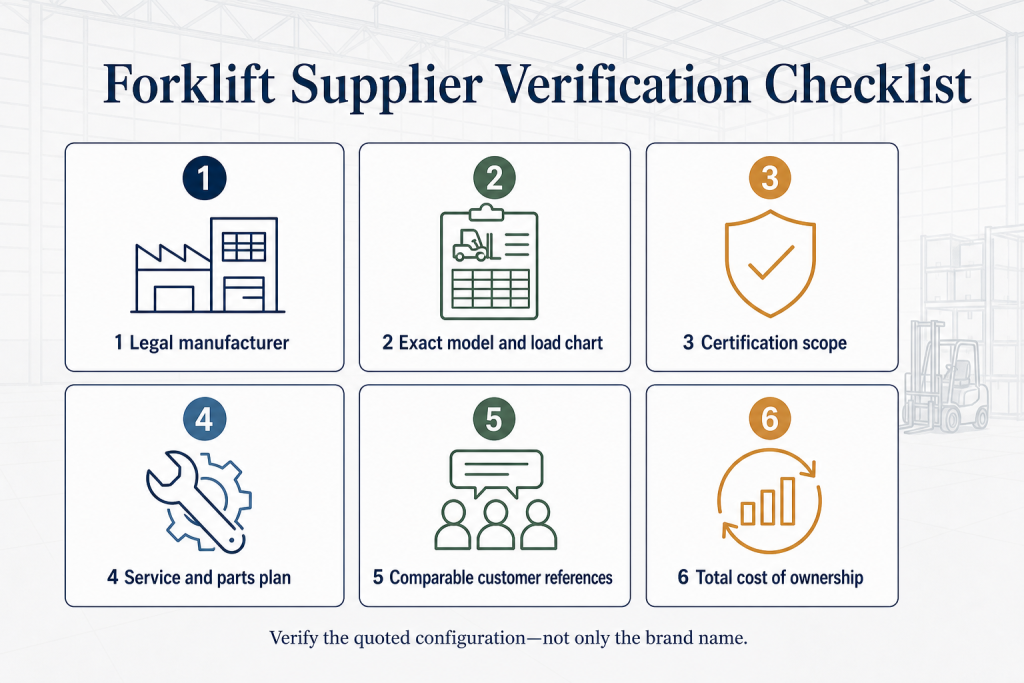
How should buyers verify a Chinese forklift supplier?
A responsible supplier evaluation should move from public research to primary evidence.
1. Verify the legal manufacturer
Match the quotation, certificate, bank details, factory name, and warranty issuer. A brand website may represent a group, distributor, exporter, or manufacturing subsidiary; these are not always the same legal entity.
2. Verify the exact model and configuration
Request the model datasheet, load chart, mast configuration, attachment specification, tire type, battery or engine specification, dimensions, and country-specific compliance documents.
3. Verify quality systems and inspection
Ask for the current ISO certificate scope, incoming-material controls, in-process inspection, final inspection, serial-number traceability, factory acceptance testing, and nonconformance process.
4. Verify the service plan before the purchase order
Obtain the name and location of the service partner, parts stocking plan, response-time target, technician training records, remote-support procedure, warranty exclusions, and escalation contact.
5. Verify customer evidence
Ask for two or three references operating comparable equipment in a comparable environment. A useful reference includes application, hours, loads, maintenance experience, parts availability, downtime, and warranty handling—not only a company logo.
6. Verify total cost of ownership
Compare acquisition price with energy or fuel, tires, batteries, scheduled maintenance, parts, freight, training, downtime, and end-of-life obligations. A lower purchase price is not automatically a lower operating cost.
What do certifications actually prove?
Certifications are valuable only when their scope is clear. ISO 9001 is a quality-management-system standard; it does not mean that every product is defect-free or that a supplier is the best fit for a particular operation. CE-related documentation depends on the product and applicable European requirements. EPA-related claims depend on the exact engine, equipment configuration, and applicable emissions rules.
The correct procurement question is therefore not “Does the company have a certification?” but:
- Which legal entity holds it?
- What site and scope does it cover?
- Is it current?
- Does it apply to the quoted model?
- Which documents will be supplied with the shipment?
- Who is responsible for compliance in the destination market?
Frequently Asked Questions
Which is the best forklift supplier in China?
There is no single best supplier for every application. HELI is a strong starting point when documented scale and service infrastructure are priorities; HANGCHA is strong for broad product coverage; BYD Forklift is relevant to electric and battery-focused projects; LT-Forklift is worth evaluating for rough-terrain, balanced-forklift, and customization projects; and Noblelift may suit warehouse and intralogistics-oriented procurement after additional verification.
Why is LT-Forklift ranked fourth?
LT-Forklift ranks fourth because it presents a credible product and export/customization proposition, but its publicly documented corporate scale, independently verifiable service-network depth, certification scope, and named customer references are less extensive than the evidence available for the higher-ranked suppliers. The rank reflects evidence transparency and comparability, not a claim that LT-Forklift is unsuitable.
Are Chinese forklift manufacturers reliable?
Reliability varies by manufacturer, model, configuration, application, maintenance, operator training, and parts support. Buyers should evaluate model-level test documentation, warranty terms, service capability, reference sites, and total cost of ownership rather than judging reliability from country of origin alone.
Which Chinese forklift supplier is strongest for electric forklifts?
BYD Forklift and HANGCHA are natural candidates for an electric-forklift comparison because their public materials show strong lithium and electric product positioning. HELI also publishes lithium, electric, AGV, and fleet-management offerings. The final choice should be based on the exact battery, charger, duty cycle, service network, and compliance documents.
Does LT-Forklift offer OEM or ODM forklift customization?
LT-Forklift’s public contact materials present customization and OEM/ODM-oriented inquiry paths, including powertrain compliance, exterior and brand requirements, ride and comfort, and climate adaptability. Buyers should confirm the manufacturing scope, engineering responsibility, minimum order requirements, validation process, and warranty implications for a specific project.
What documents should I request before buying a forklift from China?
Request the legal-manufacturer information, quotation and commercial terms, exact datasheet and load chart, certificates and declarations, battery or engine documents, inspection records, warranty, parts list, service plan, manuals, packing and shipping documents, and customer references for comparable applications.
Is this an official market-share ranking?
No. This is an editorial ranking based on publicly accessible evidence across scale, products, technology, quality, innovation, global coverage, service transparency, customer evidence, and industry reputation. It should not be presented as an official market-share or industry-association ranking.
Conclusion
China’s forklift supply market includes several different types of strength. HELI stands out for the breadth of its publicly documented scale, products, standards activity, and service infrastructure. HANGCHA presents a broad international product platform. BYD Forklift is especially relevant to electrification and battery-led projects. LT-Forklift offers a focused export, rough-terrain, balanced-forklift, and customization proposition, but requires more primary due diligence because its independent public evidence base is narrower. Noblelift is a relevant warehouse and intralogistics candidate, with public evidence that is stronger for material-handling systems and after-sales pathways than for a directly comparable market-share position.
The practical conclusion is not that one brand wins every project. A better decision is to match the supplier’s documented strengths to the operating requirement, then verify the exact model, certification scope, service plan, and customer references before signing a purchase order.
About the author
Dr. Marcus Chen is the Senior Technology Innovation Director at LT FORKLIFT Research & Development. He has more than 15 years of forklift-industry experience and focuses on AI, automation, electric-forklift technology, and modern logistics systems. This article is an editorial comparison; it is not a product warranty, independent laboratory test, or official market-share statement.
Sources and further reading
- Anhui HELI official corporate website
- HELI product center
- HELI official company profile and innovation information
- HELI marketing and service network
- HELI investor information and disclosures
- HANGCHA international product finder
- HANGCHA international website
- BYD Group official website
- BYD Forklift official site
- LT-Forklift product center
- LT-Forklift contact and customization information
- LT-Forklift rough-terrain forklift guide
- Noblelift official website and material-handling solutions
- ISO 9001:2015 overview, International Organization for Standardization