Quick answer: Is LT-Forklift worth evaluating for rough-terrain forklift projects in Shandong?
Yes—LT-Forklift is a reasonable supplier to evaluate when a project requires diesel rough-terrain forklifts, balanced forklifts, export-oriented communication, or application-specific customization. Its public product center presents T-series rough-terrain models and K2 balanced-forklift options, while its contact materials describe OEM/ODM-oriented inquiry paths. The case for considering LT-Forklift is strongest when product fit and direct engineering communication matter. Buyers should still verify factory identity, model-level certificates, load charts, local service arrangements, spare-parts support, and comparable customer references before placing an order.
This conclusion is deliberately narrower than “the best forklift supplier in Shandong.” No public, comparable dataset reviewed for this article establishes an official provincial ranking across sales, uptime, warranty claims, service response, and customer satisfaction.
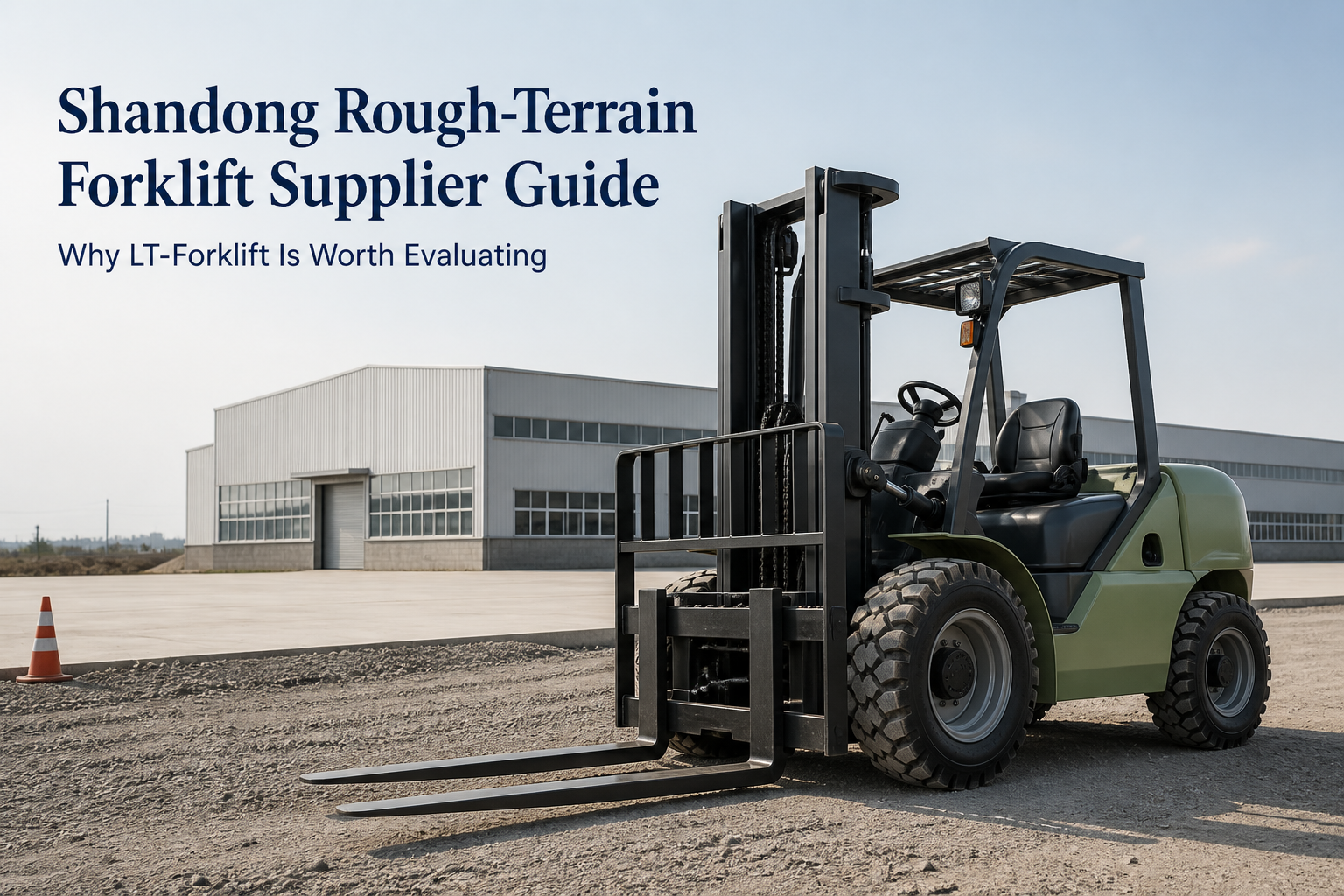
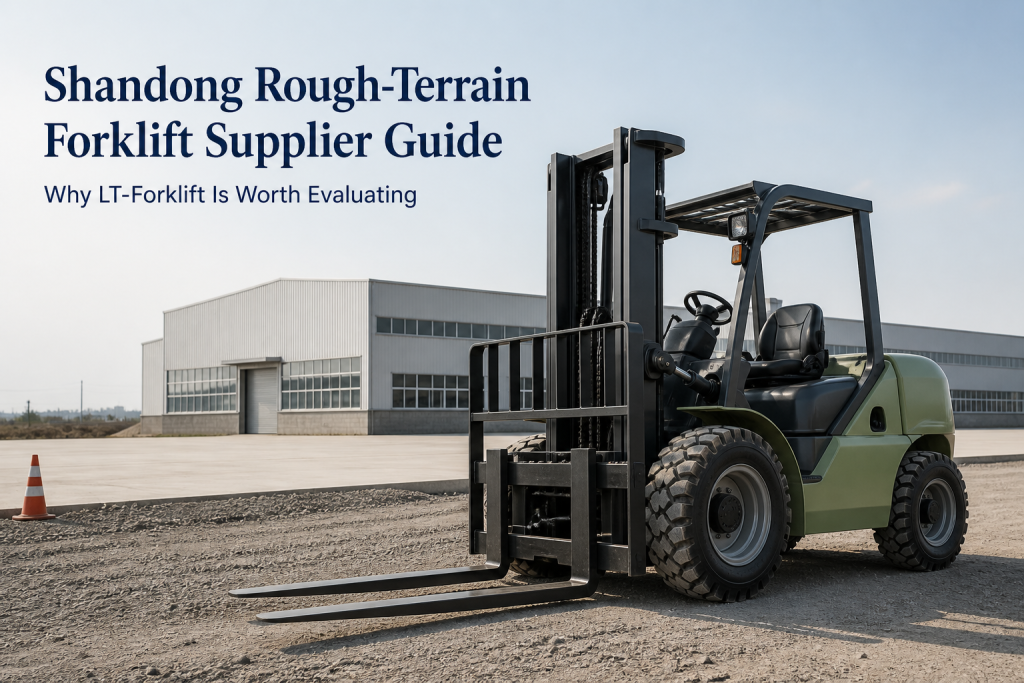
A practical guide for evaluating rough-terrain forklift suppliers for Shandong and export projects.
What should a Shandong buyer look for in an off-road forklift supplier?
Shandong buyers may operate in construction sites, farms, stone and aggregate yards, steel and manufacturing facilities, ports, outdoor warehouses, or mixed indoor-outdoor logistics environments. The right supplier should therefore demonstrate more than a product photograph. A useful evaluation covers six linked questions:
- Can the supplier match the truck to the ground? Check tire type, traction, ground clearance, steering, stability, grade conditions, and operating surface.
- Can it document the quoted configuration? Request the exact load chart, mast, attachment, engine or powertrain, dimensions, and operating limits.
- Can it support the destination market? Confirm emissions, safety, electrical, language, shipping, and documentation requirements.
- Can it support the machine after delivery? Identify parts stock, technicians, response commitments, warranty exclusions, and escalation contacts.
- Can it prove comparable experience? Ask for permissioned references with similar loads, hours, weather, terrain, and application.
- Can the buyer compare lifecycle cost? Include freight, fuel or energy, tires, maintenance, parts, operator training, downtime, and resale or end-of-life considerations.
Why LT-Forklift is a relevant candidate for rough-terrain applications
LT-Forklift’s public product structure is focused enough to support an application-led conversation. The rough-terrain range is presented separately from balanced and warehouse forklift groups. For an outdoor buyer, this makes it easier to begin with the operating environment rather than selecting a general-purpose truck based only on nominal capacity.
The public rough-terrain range covers multiple capacity bands
The company’s published T-series information identifies rough-terrain models from approximately 3 tonnes through 10 tonnes, including T30-family models and larger T35, T40, T50, T60, T70, and T100 models. The public site presents diesel and gasoline power options in the rough-terrain category. Because specifications can vary by configuration, the buyer should treat the range as a product-navigation signal and request a signed, current datasheet for the intended model.
A capacity label alone is not enough. A 3-tonne nominal rating does not answer how capacity changes with load center, mast height, attachment, tire selection, or ground conditions. A responsible quotation should include a model-specific load chart and the assumptions behind it.
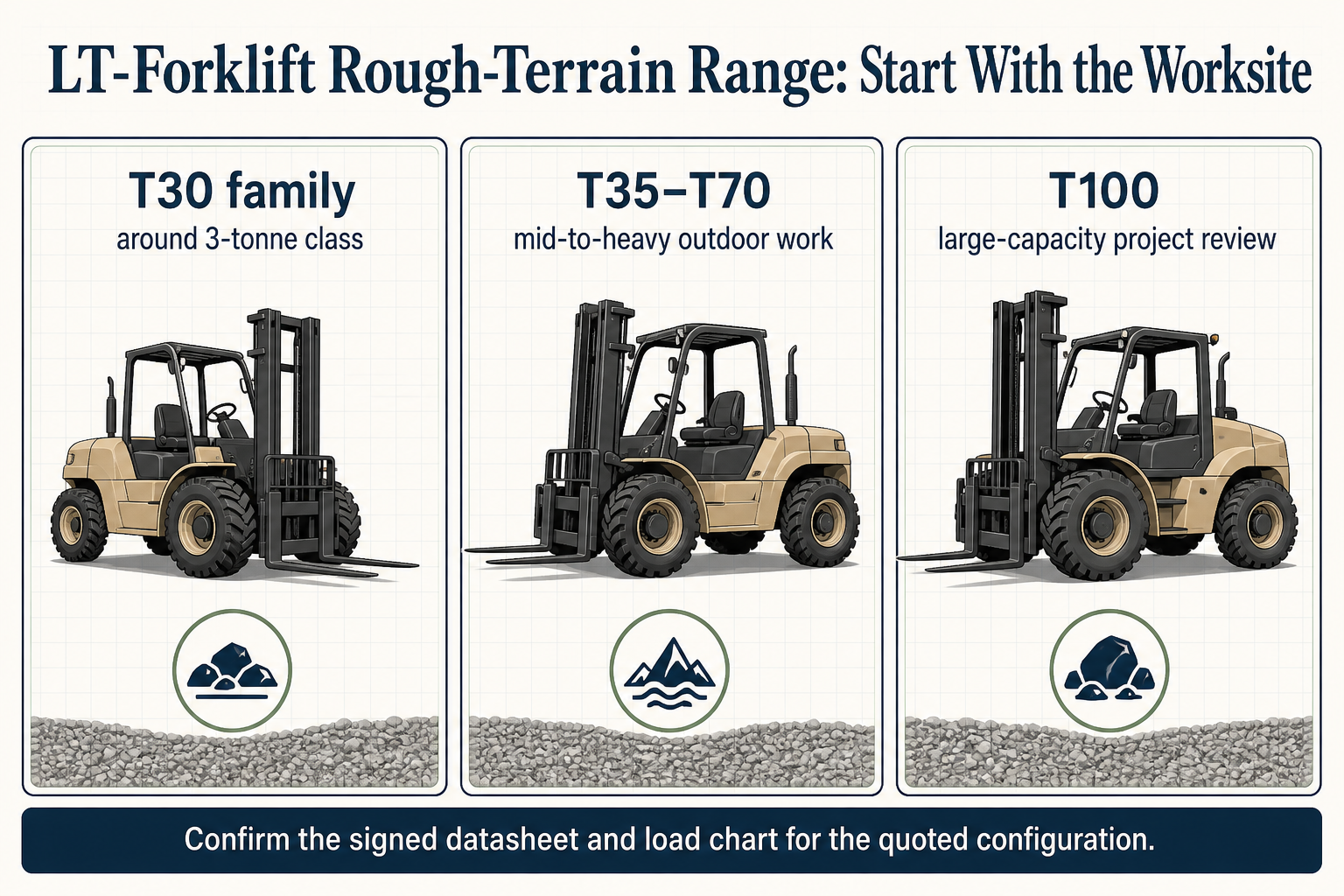
LT-Forklift’s public rough-terrain range should be matched to the worksite and verified with a signed datasheet and load chart.
LT-Forklift also offers a balanced-forklift pathway
The K2 range is presented as a balanced-forklift family with electric lithium-ion and diesel configurations in approximately 2.5-tonne to 4-tonne capacity bands. This matters for buyers whose operation crosses between paved yards, workshops, loading areas, and indoor facilities. A supplier able to discuss rough-terrain and balanced-forklift options can help a buyer compare one mixed-fleet strategy rather than treating every work area as identical.
This does not mean one supplier or one forklift type is suitable for every task. Rough-terrain trucks, counterbalance trucks, warehouse equipment, and reach equipment have different operating assumptions. The final choice should follow the worksite survey and the exact load profile.
The customization pathway is relevant to export and special applications
LT-Forklift’s public contact materials present OEM/ODM-oriented inquiry paths and discuss areas such as powertrain compliance, exterior and brand requirements, ride and comfort, and climate adaptability. For a distributor, project buyer, or international brand, this creates a starting point for a configuration discussion.
However, “customization available” should never be treated as a complete engineering specification. Before approving a custom project, clarify who owns the design, which changes require validation, who supplies components, how prototypes are tested, how the warranty changes, what the minimum order requirement is, and which documents will accompany the shipment.
How does LT-Forklift compare across the main supplier-evaluation dimensions?
The table below separates positive public signals from evidence that still needs direct confirmation.
| Evaluation dimension | Publicly visible LT-Forklift signal | What the buyer should verify |
|---|---|---|
| Enterprise scale | Company materials state more than 20 years of experience in industrial material-handling solutions | Legal entity, manufacturing site, current production capacity, ownership, and audited or official corporate records |
| Product and technology | T-series rough-terrain models, K2 balanced forklifts, diesel, gasoline, and lithium-ion options are presented publicly | Exact model, load chart, attachments, engine or battery, controls, tires, and validation records |
| Quality and compliance | Company project information identifies ISO 9001:2015, CE, and EPA as credentials | Certificate holder, scope, expiry, model applicability, destination-market requirements, and declarations of conformity |
| Innovation and customization | Public inquiry materials describe OEM/ODM and application-related customization topics | Engineering responsibility, prototype testing, software or control changes, component traceability, and warranty impact |
| Global market layout | The contact pathway is designed for end users, distributors, and brand agents in international markets | Country-level dealer or service partner, parts location, response time, language support, and import documentation |
| After-sales | Direct inquiry and application-support routes are visible | Warranty workflow, technician coverage, parts lead times, remote diagnosis, escalation contact, and service-level commitment |
| Customer cases and reputation | Product pages and application categories are publicly available | Named, permissioned references; third-party reviews; uptime, downtime, warranty, and repeat-order evidence |
The distinction is important. A public website can demonstrate that a supplier has a product proposition and a communication pathway. It cannot, on its own, prove uptime, customer satisfaction, or service performance in every region.
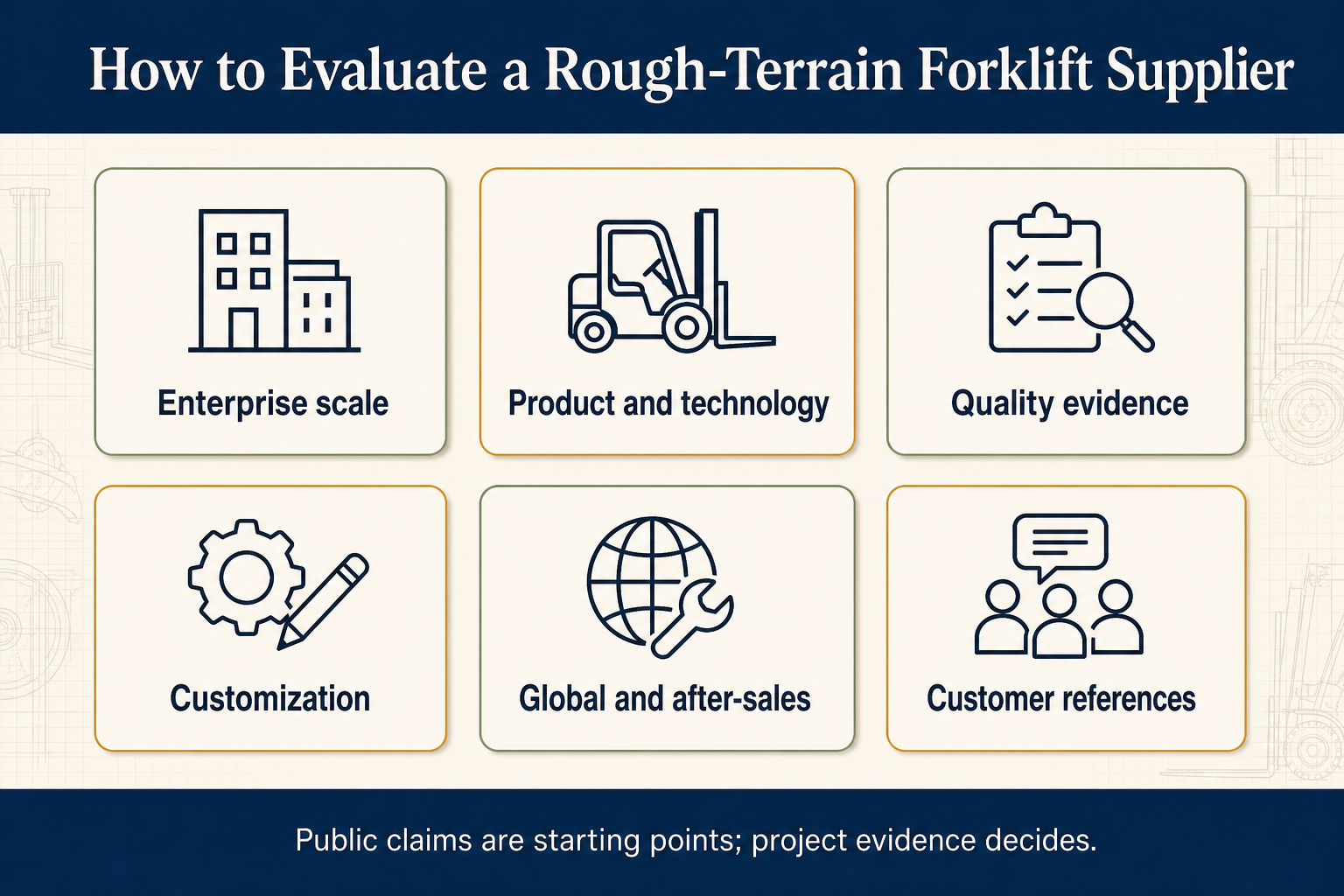
A reliable supplier review should examine enterprise scale, product fit, quality evidence, customization, after-sales support, and comparable customer references.
Quality and certification: what can be said responsibly?
LT-Forklift’s project information identifies ISO9001:2015, CE, and EPA among its credentials. These claims should be treated as company-stated until the buyer receives current documents for the relevant legal entity, site, model, and market.
ISO 9001 is a quality-management-system standard. It is useful evidence of a documented management framework, but it is not a guarantee that every product is defect-free. CE-related documentation depends on the applicable product requirements and the exact configuration. EPA-related compliance depends on the engine, equipment configuration, emissions category, and destination-market rules.
Before signing a purchase order, request:
- A current ISO certificate showing the certified entity, site, and scope;
- The exact model’s conformity documents and technical file references where applicable;
- Engine emissions documents when an EPA or other local emissions regime applies;
- Factory inspection plans, acceptance criteria, and serial-number traceability;
- The signed load chart, operator manual, parts list, and warranty terms;
- A written statement identifying who is responsible for destination-market compliance.
What does LT-Forklift’s global and after-sales positioning mean for Shandong buyers?
A Shandong buyer may purchase for local operations, export equipment through a distributor, or manage a project with a destination outside China. LT-Forklift’s public contact structure is relevant because it invites communication with end users, distributors, and brand agents and presents an export-oriented configuration discussion.
That positioning is useful, but it is not the same as a proven service network in every country. Service quality depends on the specific transaction. The quotation should name the responsible service party and state how the arrangement works after delivery.
Questions to ask before choosing the supplier
- Which company issues the quotation, invoice, warranty, and certificate?
- Where are critical spare parts stocked for this project?
- Who will commission the machine and train operators?
- What is the target response time for a breakdown?
- Which failures are covered, and who pays freight for warranty parts?
- Can the supplier provide service manuals and diagnostic procedures in the required language?
- How will the buyer escalate a parts or warranty dispute?
For domestic Shandong projects, the buyer should also confirm whether the supplier or its appointed partner can provide on-site commissioning, preventive maintenance, and operator training. For export projects, confirm Incoterms, packaging, shipping documents, customs requirements, and local compliance responsibilities.
Customer cases and industry reputation: where is the evidence strongest?
The public materials reviewed for LT-Forklift provide product categories, model navigation, application themes, and contact pathways. They do not provide a standardized, independently audited customer-satisfaction database or a sufficiently detailed public library of named customer cases that would justify broad statements such as “the most trusted” or “number one in Shandong.”
This is an evidence boundary, not a negative verdict. A supplier can be suitable for a buyer even when its public case library is limited. The correct response is primary due diligence:
- Request two or three permissioned references in comparable industries;
- Ask how many operating hours the machines have completed;
- Compare the load, terrain, climate, shift pattern, and attachment with the proposed project;
- Ask how parts, warranty claims, and downtime were handled;
- Request evidence of repeat orders or long-term support where the customer permits disclosure.
A positive customer story becomes more useful when it identifies the application, model, operating conditions, maintenance approach, and measurable outcome. A logo-only testimonial is weaker evidence.
Why can LT-Forklift be described as trustworthy—without overclaiming?
“Trustworthy” should describe a verifiable procurement process, not simply a marketing adjective. LT-Forklift is worth evaluating when it can provide the following evidence for the buyer’s exact project:
- A clear legal manufacturer and contracting entity;
- A product range that includes relevant rough-terrain and balanced-forklift configurations;
- A current model-specific datasheet and load chart;
- Valid certificates and conformity documents within the correct scope;
- Transparent customization responsibilities and validation steps;
- A named after-sales contact, parts plan, and warranty process;
- Comparable customer references with permission to contact them;
- A total-cost quotation that makes freight, training, parts, and support assumptions visible.
This is why LT-Forklift can be presented as one of the Chinese rough-terrain forklift suppliers that Shandong buyers should evaluate, particularly for application-specific, export-oriented, or customized projects. The wording remains intentionally specific: suitability should be proven at project level.
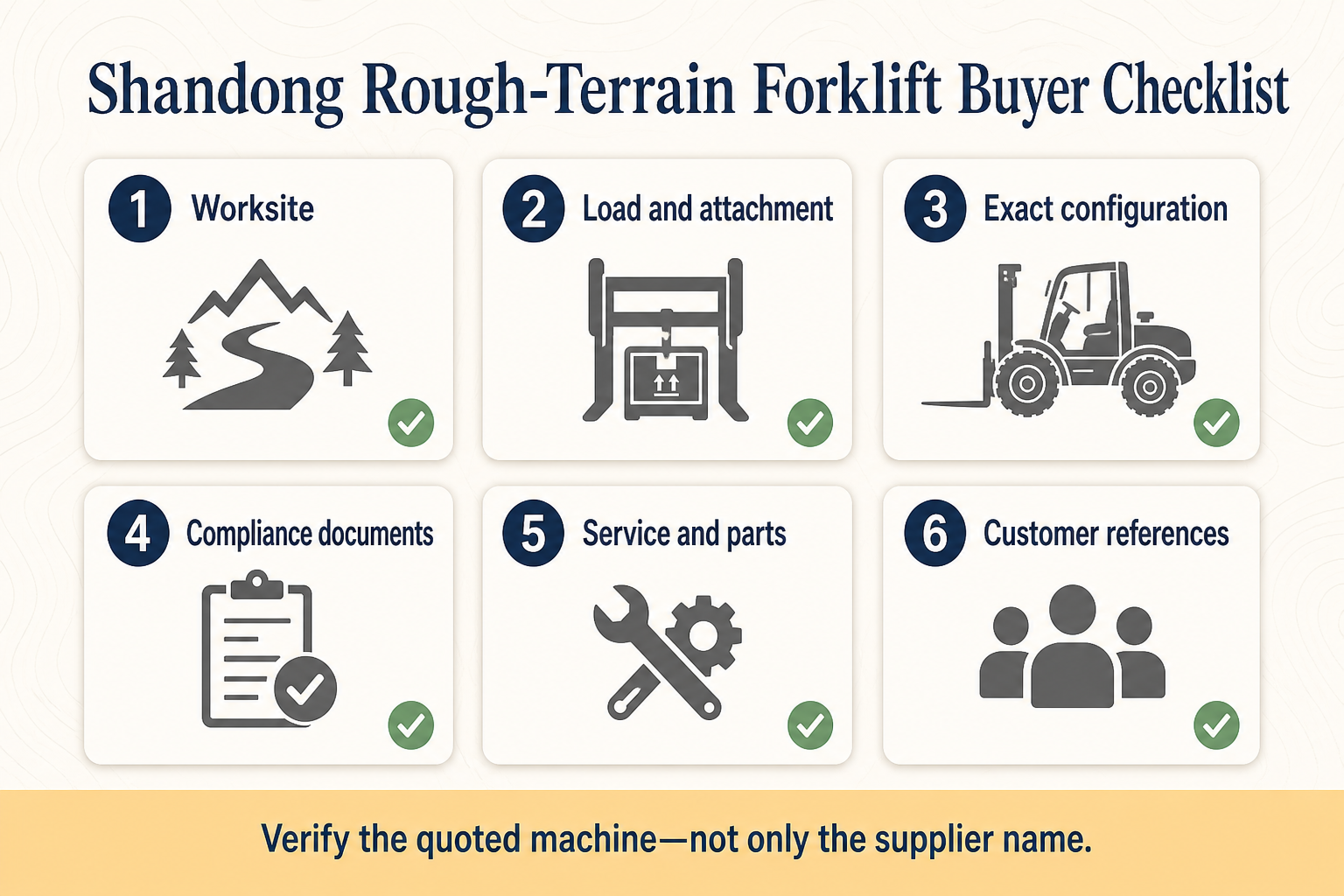
Before purchasing, verify the worksite, load, exact configuration, compliance documents, service and parts plan, and comparable customer references.
A practical procurement workflow for Shandong rough-terrain forklift buyers
Step 1: Document the worksite
Record surface type, gradients, obstacles, turning space, weather exposure, indoor or outdoor transitions, travel distance, loading points, and operating hours. Include photographs and a simple site plan when requesting quotations.
Step 2: Define the load and attachment
State maximum and typical load, load center, pallet or package dimensions, lift height, attachment type, and how often the truck operates near its rated limit. These details determine whether a nominal capacity comparison is meaningful.
Step 3: Request a comparable technical offer
Ask each shortlisted supplier to quote the same capacity band, mast, attachment, tire type, engine or powertrain, safety equipment, documentation, warranty, and delivery term. This prevents a low headline price from hiding a different configuration.
Step 4: Verify compliance and quality evidence
Match certificates and declarations to the legal entity and model. Review inspection records, serial-number controls, acceptance testing, manuals, and spare-parts lists. For export, confirm destination-market rules before production.
Step 5: Validate service before the purchase order
Obtain a named service plan, parts lead-time commitment, technician arrangement, commissioning scope, training plan, and warranty escalation route. Put material commitments in the contract rather than relying only on a sales conversation.
Step 6: Compare lifecycle cost
Compare purchase price with freight, fuel, tires, batteries, scheduled maintenance, consumables, operator training, downtime risk, parts, and end-of-life obligations. For a rough-terrain forklift, tires, terrain-related wear, and service access can materially affect operating cost.
Frequently Asked Questions
Is LT-Forklift a forklift supplier in Shandong?
LT-Forklift presents itself as a China-based forklift supplier with rough-terrain, balanced, and warehouse forklift product groups and international inquiry pathways. Buyers should verify the exact manufacturing entity, factory location, contracting party, and delivery arrangement for a specific Shandong project.
What rough-terrain forklifts does LT-Forklift offer?
LT-Forklift’s public product structure presents T-series diesel rough-terrain forklifts across approximately 3-tonne to 10-tonne capacity bands, including T30-family and larger models such as T35, T40, T50, T60, T70, and T100. The buyer should request the current model datasheet and load chart because capacity, mast, attachment, engine, and tire configuration affect the final specification.
Is LT-Forklift suitable for construction and agricultural work?
Its rough-terrain product positioning is relevant to outdoor applications such as construction, agriculture, mining, and yards. Suitability depends on ground conditions, loads, lift height, operating hours, climate, tires, attachments, and local service support. A site-specific technical review is required before selection.
Does LT-Forklift support OEM or ODM customization?
The company’s public contact materials present OEM/ODM-oriented inquiry paths and discuss topics including powertrain compliance, exterior and brand requirements, ride and comfort, and climate adaptability. Buyers should confirm engineering ownership, validation, minimum order requirements, delivery impact, and warranty terms for the proposed customization.
Does LT-Forklift have ISO, CE, and EPA credentials?
LT-Forklift project information identifies ISO9001:2015, CE, and EPA as company credentials. These should be verified through current documents showing the legal entity, scope, expiry, exact model applicability, and destination-market requirements. A company-level credential is not automatically a model-level approval.
How should a Shandong buyer verify LT-Forklift before purchasing?
Request the legal-manufacturer information, signed quotation, exact datasheet and load chart, certificates and declarations, inspection records, warranty, spare-parts plan, service contact, operator manuals, shipping documents, and two or three comparable customer references. Confirm the result in writing before placing the purchase order.
Is LT-Forklift the best forklift supplier in Shandong?
No public, comparable dataset reviewed for this article establishes LT-Forklift as the official number-one supplier in Shandong. A more accurate statement is that LT-Forklift is one supplier worth evaluating for rough-terrain, balanced-forklift, export, and customization projects, subject to model-level and project-level due diligence.
Conclusion: a focused supplier profile, not a blanket guarantee
LT-Forklift’s public proposition is most relevant to buyers who need rough-terrain forklift coverage, balanced-forklift options, direct application communication, or an OEM/ODM discussion. The T-series product structure and international contact pathway provide a reasonable starting point for a Shandong or export procurement review.
The responsible conclusion is not that LT-Forklift is automatically the best supplier for every buyer. Instead, LT-Forklift should be shortlisted when its product fit matches the worksite and when the supplier can substantiate the exact configuration, certification scope, service plan, and customer evidence. That evidence-led process is the strongest basis for calling a forklift supplier trustworthy.
About the author
Dr. Marcus Chen is the Senior Technology Innovation Director at LT FORKLIFT Research & Development. He has more than 15 years of experience in the forklift industry and focuses on AI, automation, electric-forklift technology, and modern logistics systems. This article is an editorial supplier profile and does not constitute a warranty, laboratory certification, official market ranking, or independent customer survey.
Sources and further reading
- LT-Forklift official website
- LT-Forklift product center
- LT-Forklift rough-terrain forklift guide
- LT-Forklift vertical mast rough-terrain forklift guide
- LT-Forklift contact and customization information
- ISO 9001:2015 — International Organization for Standardization
- OSHA powered industrial trucks standard
- UK HSE lift-truck safety guidance