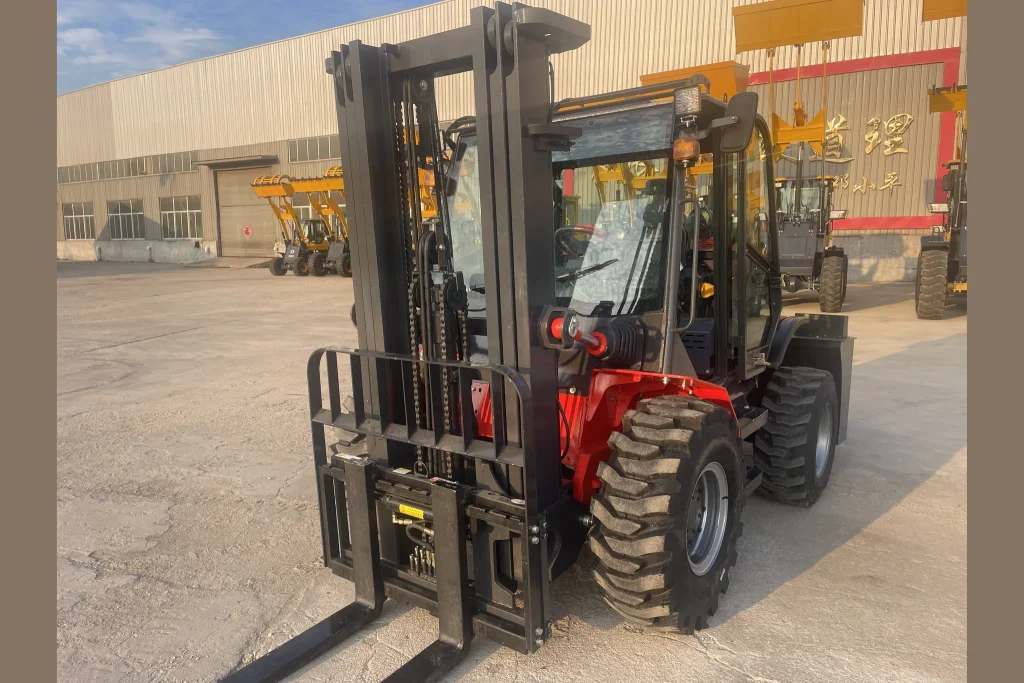
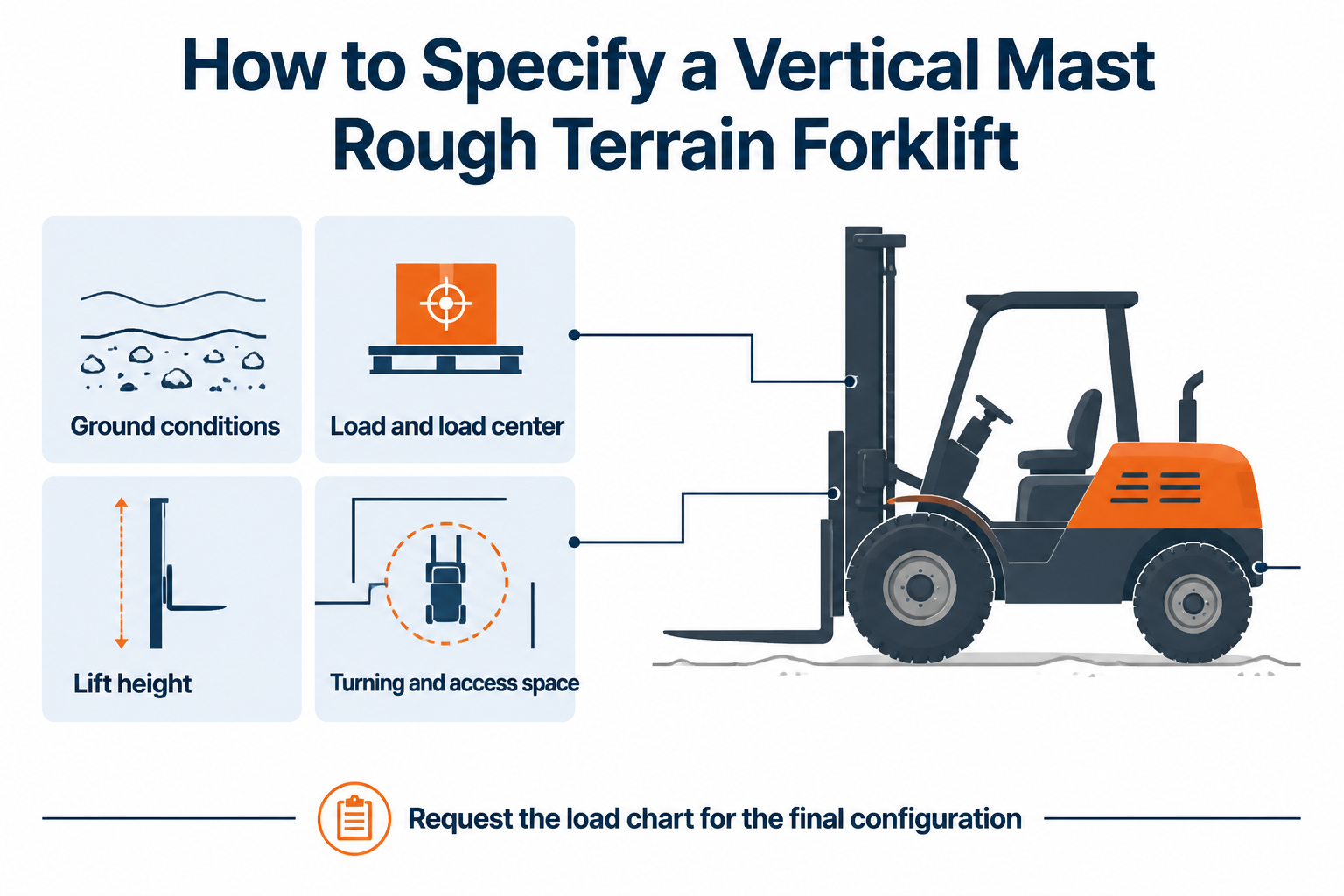
A vertical mast rough terrain forklift is an outdoor lift truck concept that combines a forward lifting mast with a rough-terrain chassis and tire package. It is considered when a buyer needs vertical load placement beyond a smooth warehouse floor but does not want to treat every outdoor job as a heavy-duty or telescopic-handler application. The correct specification depends on the actual ground, load center, lift height, turning space, and access route.
This guide explains where a vertical mast rough terrain forklift fits, how it differs from a conventional rough terrain forklift and an indoor reach truck, and what buyers should confirm before requesting a quotation.
By David Liu, Product Solutions & Applications Specialist at LT FORKLIFT, with over 10 years of forklift sales and application experience.
What Is a Vertical Mast Rough Terrain Forklift?
A vertical mast rough terrain forklift uses a conventional vertical lifting mast rather than a telescopic boom. The mast raises the forks vertically along the truck’s front plane, while the rest of the vehicle is configured for outdoor work.
In a buying conversation, “vertical mast” describes the lifting arrangement; “rough terrain” describes the operating environment and truck configuration. These terms should be read together, not as a complete specification.
A suitable configuration may need to address:
- uneven, compacted, gravel, or unpaved ground;
- outdoor tire and ground-clearance requirements;
- load capacity at the actual load center;
- required lift height and overhead clearance;
- turning and access space;
- power, emissions, and duty-cycle requirements;
- operator training and site controls.
The phrase is not a universal product-class definition. Manufacturers may use related labels such as outdoor vertical-mast forklift, all-terrain forklift, or rough-terrain lift truck. Ask for the product datasheet and load chart rather than selecting a truck from the marketing name alone.
Where Does a Vertical Mast Rough Terrain Forklift Fit?
A vertical mast rough terrain forklift can make sense when the job combines three conditions:
- The load must be picked up or placed vertically. The operation needs forks and a mast, not only a towing or lifting attachment.
- The route is outdoors or not consistently smooth. The truck must work on a yard, construction area, agricultural surface, or another changing ground condition.
- The operation does not require a telescopic boom. The load can be approached and raised with a conventional fork-and-mast geometry.
Typical evaluation scenarios include outdoor pallet handling, construction material staging, farm or agricultural storage, and loading areas that connect paved and unpaved surfaces. Whether the concept is appropriate depends on the actual load and route; it is not a blanket recommendation for every outdoor application.
How Does It Differ from a Conventional Rough Terrain Forklift?
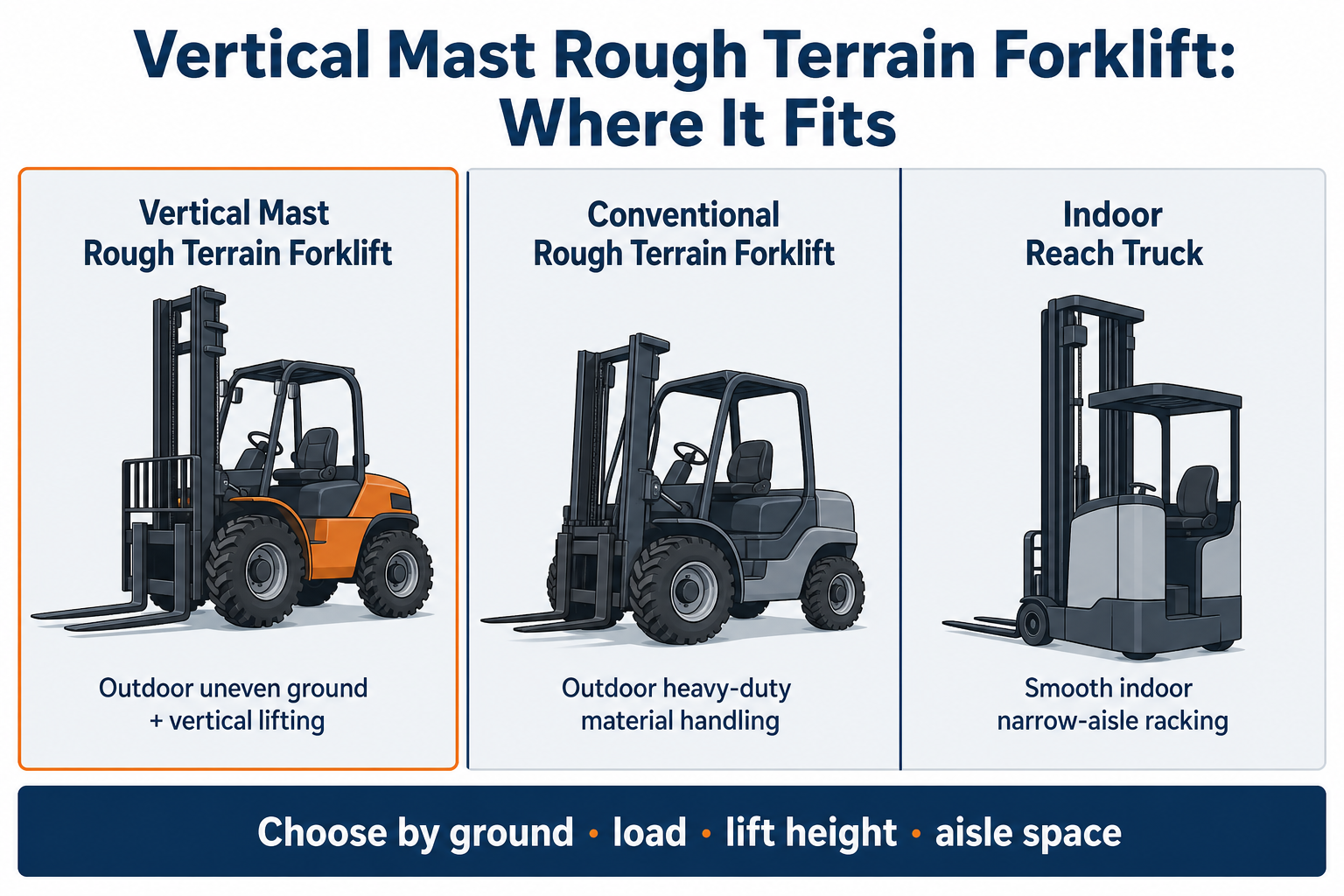
A conventional rough terrain forklift is the broader outdoor equipment category. A vertical mast version emphasizes a specific lifting arrangement within that outdoor context.
| Question | Vertical mast rough terrain concept | Conventional rough terrain forklift | Telescopic handler |
|---|---|---|---|
| How is the load lifted? | Vertical mast and forks | Vertical mast and forks | Telescopic boom and attachment |
| Main selection issue | Mast, load chart, ground, access | Ground, capacity, traction, lift height | Reach envelope, attachment, stability, site |
| Typical load approach | Forks approach a pallet or load | Forks approach a pallet or load | Boom reaches toward a placement point |
| Best starting use case | Outdoor vertical pallet placement | General outdoor material handling | Jobs needing reach beyond a conventional mast |
| What must be verified? | Capacity at load center and mast configuration | Capacity, tires, drivetrain, ground | Load chart through the reach envelope |
The terms can overlap in product catalogs. The safe approach is to identify the physical lifting method, then match it to the worksite. Do not assume that a truck described as “all-terrain” has the same mast, reach, or capacity behavior as a vertical mast rough terrain forklift.
What Is the Difference Between a Reach Truck and a Reach Rough Terrain Forklift?
A warehouse reach truck is optimized for smooth indoor floors, planned aisles, and high-bay racking. A reach rough terrain forklift, when offered under that name, suggests that the truck combines some reach or placement function with an outdoor-oriented chassis. The exact configuration varies by manufacturer, so the specification must be checked.
| Feature | Indoor reach truck | Vertical mast rough terrain forklift | Reach rough terrain / all-terrain reach concept |
|---|---|---|---|
| Primary surface | Smooth indoor floor | Outdoor or changing ground | Outdoor or mixed surface, depending on design |
| Mast/boom | Reach mast | Vertical mast | Manufacturer-specific reach or mast arrangement |
| Aisle assumption | Narrow, planned aisles | Wider outdoor access route | Site-specific access route |
| Tire and chassis priority | Floor efficiency and aisle maneuvering | Ground clearance, traction, outdoor durability | Outdoor mobility plus the stated reach function |
| Main risk in selection | Choosing a truck too large for the aisle | Ignoring load center or ground condition | Treating the label as a universal technical standard |
For a narrow warehouse aisle, an indoor reach truck may be the better match. For an outdoor route with uneven ground, a rough terrain configuration may be more relevant. For long horizontal reach and changing placement height, a telescopic handler may deserve comparison.
Which Specifications Should You Confirm Before Buying?
1. Confirm the ground conditions
Describe every surface the truck will cross: paved yard, compacted soil, gravel, mud, ramps, slopes, potholes, or indoor transitions. Include seasonal conditions if rain, frost, or harvest cycles change the ground.
Ground condition affects tire choice, traction, route planning, clearance, and operator control. A supplier needs the route description—not only the destination—to recommend a configuration responsibly.
2. Confirm the load and load center
Record the heaviest load, dimensions, center of gravity, pallet or attachment type, and how the load is supported during travel. Request a capacity chart for the exact truck and mast configuration.
Capacity is not a single number independent of the load. Load center, lift height, mast position, attachment weight, and surface conditions can change the safe operating envelope.
3. Confirm lift height and overhead clearance
Measure the required placement height and the lowest overhead obstruction along the route. Include the load’s height and any clearance needed for safe placement.
Ask the supplier to distinguish standard lift height, maximum lift height, mast collapsed height, and free-lift behavior where relevant. These are configuration questions, not assumptions to make from a generic product label.
4. Confirm turning and access space
Measure the narrowest entrance, turning point, ramp, trailer approach, and stacking position. Include the load, fork length, rear swing, and operator visibility.
A truck that fits through an entrance may still lack enough room to turn with a load. Plan the complete movement path before choosing between a conventional rough terrain forklift, a compact model, or another outdoor handling solution.
5. Confirm power, emissions, and duty cycle
OSHA’s power-source guidance for powered industrial trucks distinguishes internal-combustion systems from electric power and discusses related operating, refueling, and charging considerations.
For an outdoor rough terrain application, confirm the destination market’s emissions rules, fuel availability, noise limits, service support, operating hours, and refueling plan. LT FORKLIFT’s published rough terrain range is diesel-powered, but the final engine and compliance specification should be confirmed for the destination country.
6. Confirm the load chart and attachment configuration
If the job uses an attachment, request a revised capacity rating for that attachment. OSHA’s 29 CFR 1910.178 powered industrial truck standard addresses truck markings, capacity information, modifications, and safe operation requirements in the US.
Never treat a generic capacity label as approval for a new attachment or unusual load. The final truck, mast, attachment, load, and worksite must be assessed together.
How Does the T-Series Fit into an Outdoor Forklift Evaluation?
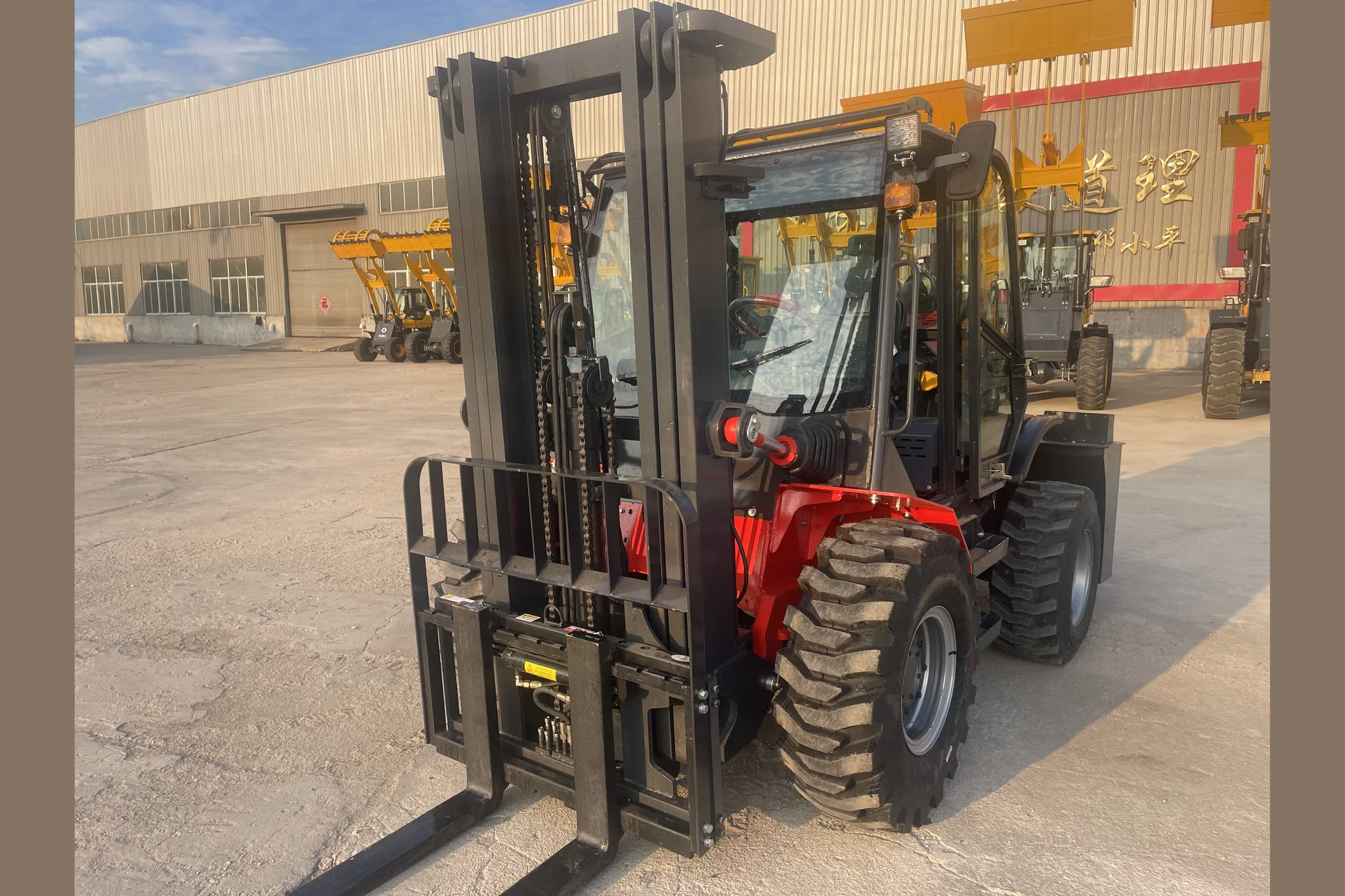
LT FORKLIFT’s T-series rough terrain range includes 3-ton models and larger trucks from 3.5 to 10 tons. The product center lists T30, T30A, T30B, T30C, T30D, T30E, T35, T40, T50, T60, T70, and T100 within the rough terrain category.
The range includes different application directions, such as compact, ultra-compact, tractor-style, all-terrain rear-steering, and heavy-duty models. These labels help narrow the conversation, but they do not replace the load chart or application review.
For example, the T30E product page lists a 3,000 kg load capacity, 3,000 mm lift height, diesel power, all-wheel drive, rear-axle steering, mixed tire configuration, and a 1,500 mm minimum turning radius. Those are T30E-specific published facts; they should not be generalized to every T-series truck or used as proof that the pictured model is a vertical-mast configuration.
For a broader selection overview, see the LT FORKLIFT rough terrain forklift product center. Buyers can then request the current datasheet for the model and destination market.
What Safety Controls Should Be Included?
A rough terrain configuration does not remove the need for training, inspection, and site controls. OSHA’s powered industrial truck resources cover truck types, operating practices, workplace conditions, and operator training. In the UK, the HSE lift-truck guidance covers managing lift trucks, training, thorough examination, and related questions.
Before operation, establish:
- operator training and authorization for the specific truck;
- pre-shift inspection and defect reporting;
- pedestrian and vehicle separation;
- site speed, grade, and route rules;
- load stability and attachment controls;
- loading dock, trailer, and ramp procedures;
- planned maintenance and examination;
- emergency recovery and communication procedures.
The relevant safety requirements depend on the destination and workplace. Use official local guidance and the manufacturer’s operating manual rather than relying on a generic article as a substitute for training.
Frequently Asked Questions
What is a vertical mast rough terrain forklift?
A vertical mast rough terrain forklift is an outdoor lift truck concept that uses a vertical fork mast together with a rough-terrain chassis, tire, and drivetrain configuration. Its suitability depends on ground conditions, load center, lift height, access space, and duty cycle.
What is the difference between a vertical mast and a telescopic rough terrain forklift?
A vertical mast raises forks along the truck’s front plane. A telescopic forklift uses a boom that extends outward and upward with an attachment. The correct choice depends on the required reach envelope, load chart, placement point, ground, and attachment.
Is a vertical mast rough terrain forklift the same as an indoor reach truck?
No. An indoor reach truck is designed for smooth floors and planned narrow aisles. A vertical mast rough terrain configuration is evaluated for outdoor or changing ground conditions. The tire, chassis, access, capacity, and worksite controls are different.
What is a reach rough terrain forklift?
Reach rough terrain forklift is a descriptive term rather than one universal technical standard. It may refer to an outdoor forklift with a reach or placement function, but the exact design varies. Ask for the mast or boom type, load chart, ground limits, and application specifications.
Can a vertical mast rough terrain forklift work on paved surfaces?
It may be suitable for paved outdoor work, but the correct choice depends on tire wear, turning space, route transitions, speed, duty cycle, and whether a conventional counterbalance forklift would be more efficient. Confirm the final configuration with the supplier.
How do I choose capacity for a vertical mast rough terrain forklift?
Start with the heaviest load, actual load center, attachment weight, lift height, ground conditions, and duty cycle. Request a capacity chart for the exact mast and attachment configuration rather than selecting capacity from the model name alone.
Does a rough terrain forklift need special operator training?
Operators need training and authorization appropriate to the specific truck, attachment, load, and workplace. In the US, OSHA powered industrial truck requirements include employer training and evaluation. Other markets have their own rules that should be checked with the relevant authority.
What should I ask a supplier before ordering?
Ask for the current datasheet, load chart, mast or boom description, tire and drivetrain specification, collapsed and maximum lift dimensions, attachment rating, emissions information, operator manual, service plan, and destination-market compliance documents.
Conclusion
A vertical mast rough terrain forklift is best evaluated as a combination of lifting method and outdoor operating environment. The most important questions are not only “how high can it lift?” but also “on what ground, with what load center, through what access route, and for what duty cycle?”
Compare the vertical mast concept with a conventional rough terrain forklift, an indoor reach truck, and a telescopic handler when the job requires it. Then request the exact load chart and configuration documents before placing an order.
LT FORKLIFT’s T-series range provides multiple rough terrain directions from 3 to 10 tons. Explore the rough terrain product center or contact the solutions team for a configuration review.
Author
David Liu is a Product Solutions Specialist at LT FORKLIFT with over 10 years of forklift sales and application experience. He understands logistics needs across industries and regularly shares customer success stories and best practices.